Reported speech (ประโยครายงาน) เป็นหนึ่งในหัวข้อสำคัญและพบได้บ่อยในไวยากรณ์ภาษาอังกฤษ ทั้งในข้อสอบและการสื่อสารในชีวิตจริง บทความนี้จะช่วยให้คุณเข้าใจว่าการรายงานคำพูดคืออะไร เชี่ยวชาญโครงสร้างทั้งหมดของการรายงานคำพูด วิธีการเปลี่ยนกาล คำสรรพนาม และกริยาที่ใช้ในการรายงานโดยเฉพาะ เช่น การแนะนำ การให้คำปรึกษา และการปฏิเสธ

Reported Speech คือ อะไร
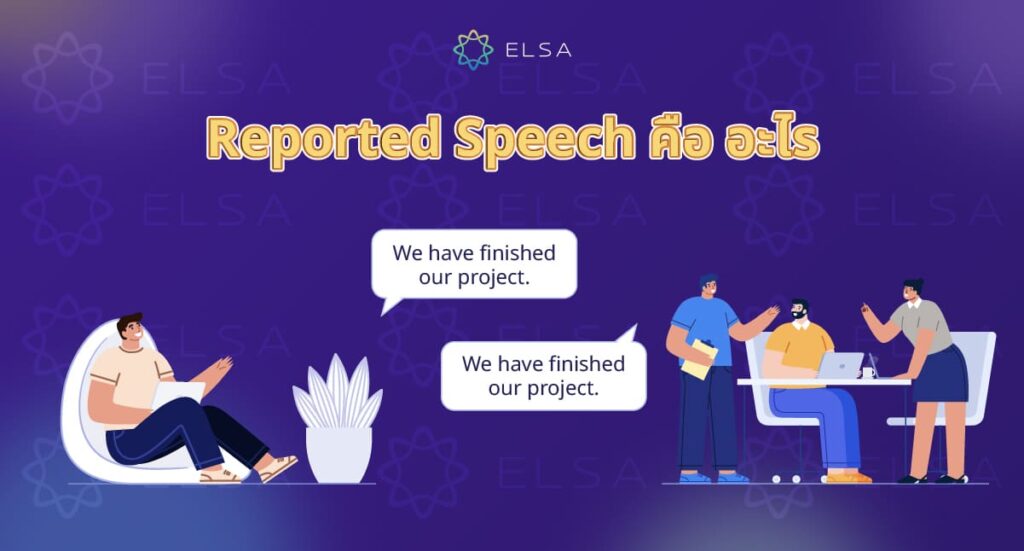
Indirect Speech หรือที่เรียกว่า Reported Speech เป็นประโยคที่ใช้เมื่อเราต้องการเล่าหรือเล่าประโยคที่คนอื่นพูด
สอบก่อนเข้าฟรี

Reported Speech (ประโยครายงาน) เป็นประโยคประเภทหนึ่งที่ใช้ในการเล่าหรือบอกเล่าสิ่งที่ผู้อื่นพูด แทนที่จะพูดซ้ำคำพูดนั้นตรงๆ
กล่าวอีกนัยหนึ่ง ประโยครายงาน คือการแปลงคำพูดโดยตรง (Direct Speech) ให้เป็นคำพูดโดยอ้อมโดยการเล่าเนื้อหาของสิ่งที่ได้ยิน
ลองอ่านออกเสียง 50 รายการนี้ดู แล้วดูคะแนนของคุณ
ตัวอย่างเช่น ลิซ่าพูดประโยคต่อไปนี้:
เรามี 2 วิธีในการเล่าให้คนอื่นรู้ว่า ลิซ่าพูดอะไร:
- ทำซ้ำตามที่ลิซ่าพูดทุกประการ: Lisa said, ‘I’m tired.’ = ลิซ่าบอกว่า ‘ฉันเหนื่อย’
- หรือเล่าคำพูดของลิซ่า: Lisa said that she was tired. = ลิซ่าบอกว่าเธอเหนื่อย
→ แบบนี้เรียกว่า Reported Speech
>>> อ่านเพิ่มเติม:
- 12 tense ในภาษาอังกฤษ: โครงสร้าง หลักการใช้ และสัญญาณการรับรู้
- Future Perfect Tense รวบรวมความรู้
วิธีเปลี่ยน Direct Speech เป็น Reported Speech
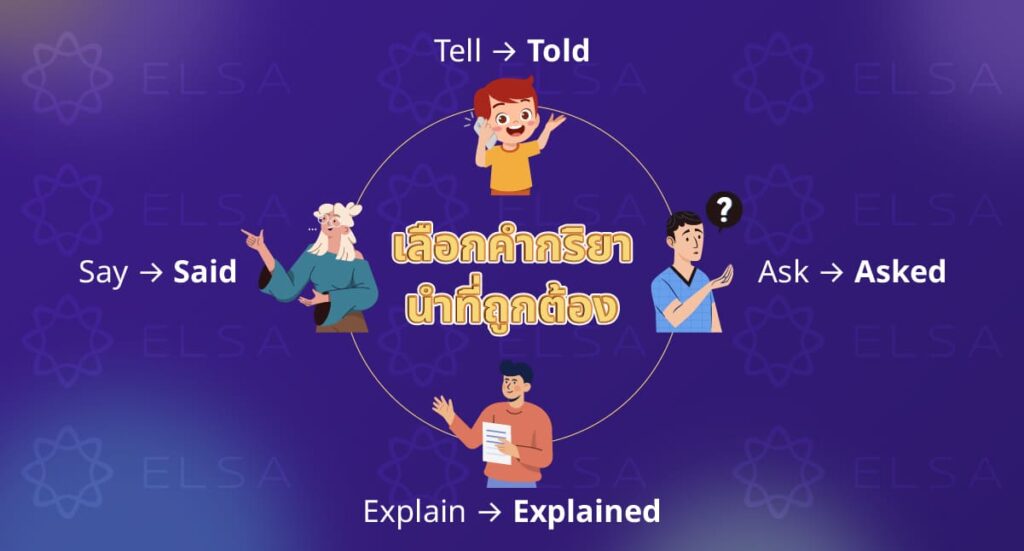
เมื่อเปลี่ยนจากประโยคบอกเล่าโดยตรง (Direct Speech) ไปเป็นประโยครายงาน (Reported Speech) ขั้นตอนแรกและสำคัญที่สุดคือการเลือกคำกริยานำหน้าที่ถูกต้อง เพื่อสะท้อนจุดประสงค์และรายละเอียดปลีกย่อยของประโยคเดิมได้อย่างแม่นยำ
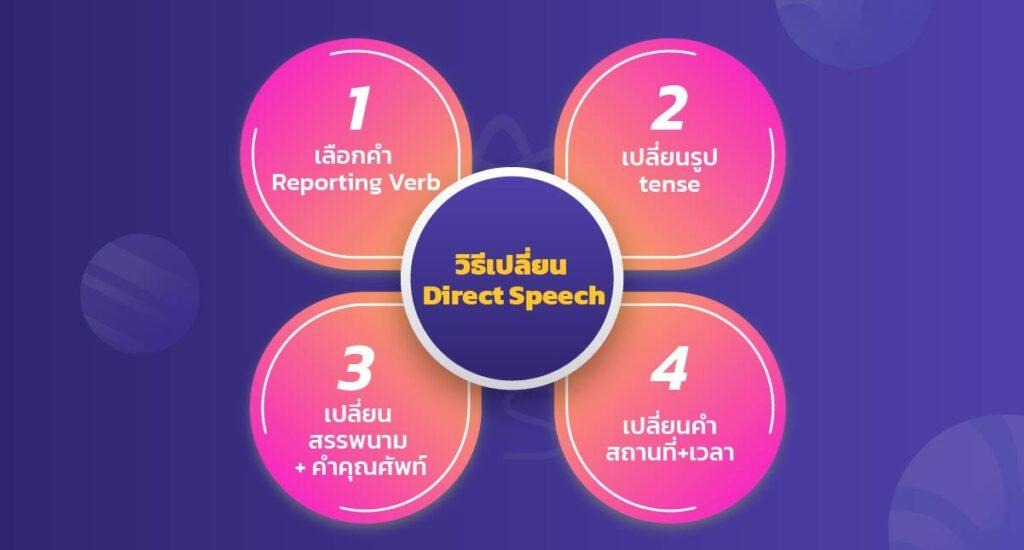
การเลือกคำกริยาบอกเล่าที่ถูกต้อง
ด้านล่างนี้คือกริยาบอกเล่าที่ใช้กันทั่วไป พร้อมความหมายในภาษาไทย และตัวอย่างสั้นๆ เพื่อช่วยให้คุณจำได้:
| กริยาบอกเล่า | ความหมาย | ตัวอย่าง |
|---|---|---|
| say | พูด | Lisa said that she was tired. |
| tell | บอก | He told me that he was busy. |
| ask | ถาม | She asked if I liked coffee. |
| explain | อธิบาย | He explained that the test was easy. |
| advise | แนะนำ | The doctor advised me to rest. |
| promise | สัญญา | She promised that she would call. |
| warn | เตือน | He warned me not to be late. |
| suggest | เสนอแนะ | She suggested going home early. |
ข้อควรสังเกต:
- Say ไม่จำเป็นต้องมีกรรม ในขณะที่ tell ต้องมีกรรม (tell someone)
- ขึ้นอยู่กับจุดประสงค์ของประโยคเดิม (บอก ถาม แนะนำ เตือน ฯลฯ) ให้เลือกกริยาบอกเล่าที่เหมาะสม เช่น ask, advise, warn…
- เมื่อใช้ ประโยครายงาน เนื้อหาของคำพูดจะไม่ถูกพูดซ้ำแบบคำต่อคำ แต่จะถูกเล่าใหม่ → มักเกี่ยวข้องกับการเปลี่ยนแปลงกาล สรรพนาม และคำวิเศษณ์บอกเวลา/สถานที่
- Reported Speech ทำให้ประโยคฟังดู เป็นธรรมชาติและเป็นวิชาการมากขึ้น และมักใช้ในข้อความที่เป็นลายลักษณ์อักษร ข้อสอบ และการสื่อสารทางอ้อม
>>> อ่านเพิ่มเติม:
- วิธีใช้ Past Perfect Tense (กาลอดีตก่อนหน้า) ที่เข้าใจง่ายที่สุด
- ไวยากรณ์ภาษาอังกฤษพื้นฐานทั้งหมดที่คุณต้องรู้และวิธีการใช้
- Have has ใช้ยังไง ให้ถูกต้องตามหลักไวยากรณ์และเข้าใจได้ง่าย
กฎการเปลี่ยนกาล
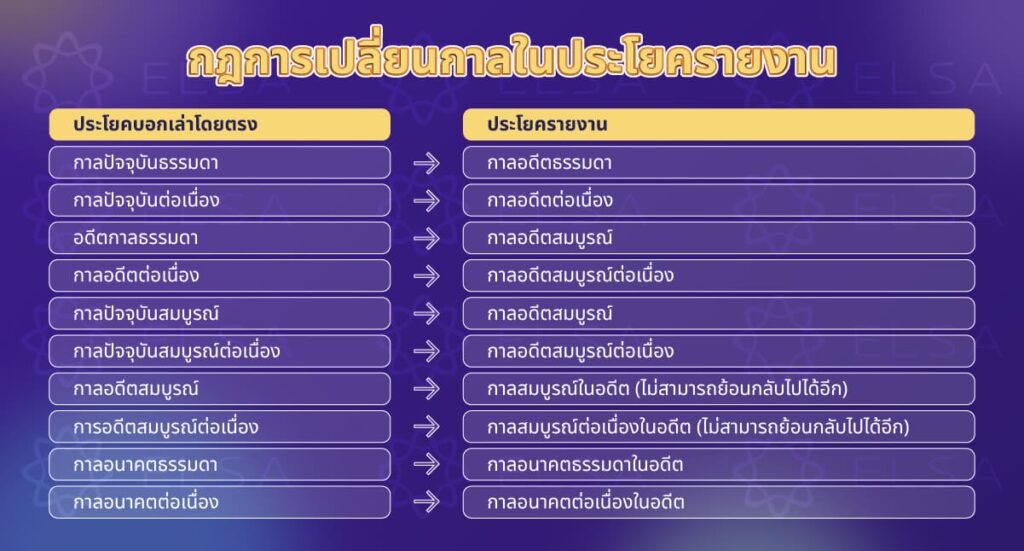
เมื่อแปลงจากประโยคบอกเล่าโดยตรง (Direct Speech) เป็นประโยครายงาน (Reported Speech) หากกริยาที่ใช้ในการบอกเล่าอยู่ในรูปอดีต (เช่น (said, told, asked…) กริยาในประโยคที่ถูกบอกเล่ามักจะต้องเปลี่ยนไปอยู่ในรูปอดีตที่สอดคล้องกันด้วย
| ประโยคบอกเล่าโดยตรง | ประโยครายงาน |
|---|---|
| Present Simple Tense (กาลปัจจุบันธรรมดา) | Past Simple Tense (กาลอดีตธรรมดา) |
| Present Continuous Tense (กาลปัจจุบันต่อเนื่อง) | Past Continuous Tense (กาลอดีตต่อเนื่อง) |
| Past Simple Tense (อดีตกาลธรรมดา) | Past Perfect Tense (กาลอดีตสมบูรณ์) |
| Past Continuous Tense (กาลอดีตต่อเนื่อง) | Past Perfect Continuous Tense (กาลอดีตสมบูรณ์ต่อเนื่อง) |
| Present Perfect Tense (กาลปัจจุบันสมบูรณ์) | Past Perfect Tense (กาลอดีตสมบูรณ์) |
| Present Perfect Continuous Tense (กาลปัจจุบันสมบูรณ์ต่อเนื่อง) | Past Perfect Continuous Tense (กาลอดีตสมบูรณ์ต่อเนื่อง) |
| Past Perfect Tense (กาลอดีตสมบูรณ์) | กาลสมบูรณ์ในอดีต (ไม่สามารถย้อนกลับไปได้อีก) |
| Past Perfect Continuous Tense (กาลอดีตสมบูรณ์ต่อเนื่อง) | กาลสมบูรณ์ต่อเนื่องในอดีต (ไม่สามารถย้อนกลับไปได้อีก) |
| Future Simple Tense (กาลอนาคตธรรมดา) | กาลอนาคตธรรมดาในอดีต |
| Future Continuous Tense (กาลอนาคตต่อเนื่อง) | กาลอนาคตต่อเนื่องในอดีต |
ตัวอย่าง:
- กาลปัจจุบันธรรมดา: “I love this song”, she said. -> กาลอดีตธรรมดา: She said that she loved that song.
- กาลปัจจุบันต่อเนื่อง: “We are studying English”, they said. -> กาลอดีตต่อเนื่อง: They said that they were studying English.
- กาลปัจจุบันสมบูรณ์: “He has already eaten lunch”, she said. -> กาลอดีตสมบูรณ์: She said that he had already eaten lunch.
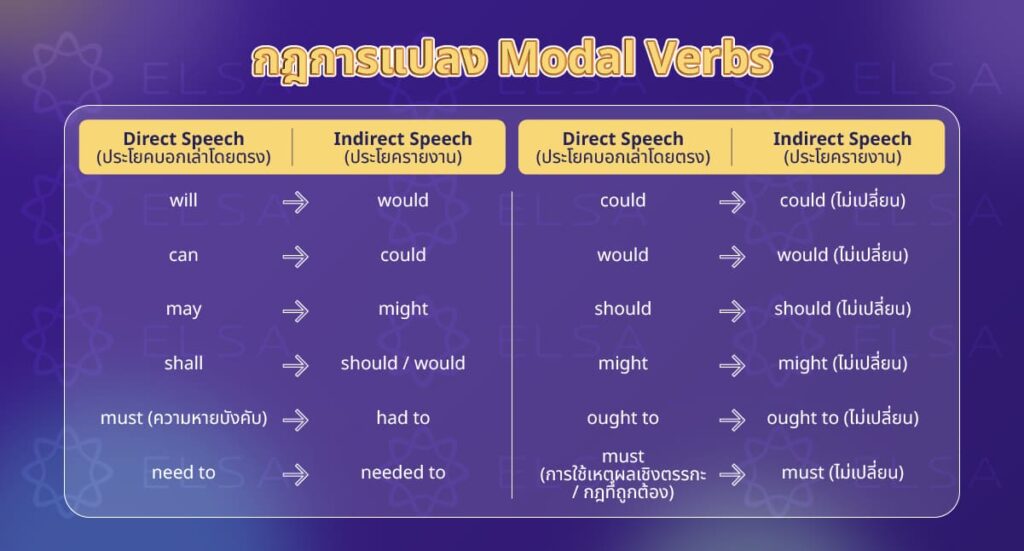
กฎการแปลง Modal Verbs (Auxiliary Verbs)
เมื่อแปลงจากประโยคบอกเล่าโดยตรง (Direct Speech) เป็นประโยครายงาน (Indirect Speech) กริยาช่วย (Modal Verb) มักจะเปลี่ยนกาลกลับไปให้ตรงกับกาลของกริยาหลัก แต่ไม่ใช่ว่ากริยาช่วยทุกตัวจะเปลี่ยนกาลเสมอไป
| Direct Speech (ประโยคบอกเล่าโดยตรง) | Indirect Speech (ประโยครายงาน) |
|---|---|
| will | would |
| can | could |
| may | might |
| shall | should / would |
| must (ความหายบังคับ) | had to |
| need to | needed to |
| could | could (ไม่เปลี่ยน) |
| would | would (ไม่เปลี่ยน) |
| should | should (ไม่เปลี่ยน) |
| might | might (ไม่เปลี่ยน) |
| ought to | ought to (ไม่เปลี่ยน) |
| must (การใช้เหตุผลเชิงตรรกะ / กฎที่ถูกต้อง) | must (ไม่เปลี่ยน) |
ข้อสังเกต: การเปลี่ยน modal หรือไม่ขึ้นอยู่กับบริบทและจังหวะเวลาในการเล่าเรื่อง
ตัวอย่างที่ 1: ไม่เปลี่ยน modal – ยังคงถูกต้องในปัจจุบัน
- ประโยคบอกเล่าโดยตรง: The doctor said, “You must wear a helmet when riding a bike.”
-> ประโยครายงาน: The doctor said that I must wear a helmet when riding a bike.
ตัวอย่างที่ 2: เปลี่ยน modal – ถูกต้องเฉพาะในอดีตเท่านั้น
- ประโยคบอกเล่าโดยตรง: She said, “I can finish the project yesterday.”
-> ประโยครายงาน: She said that she could finish the project yesterday.
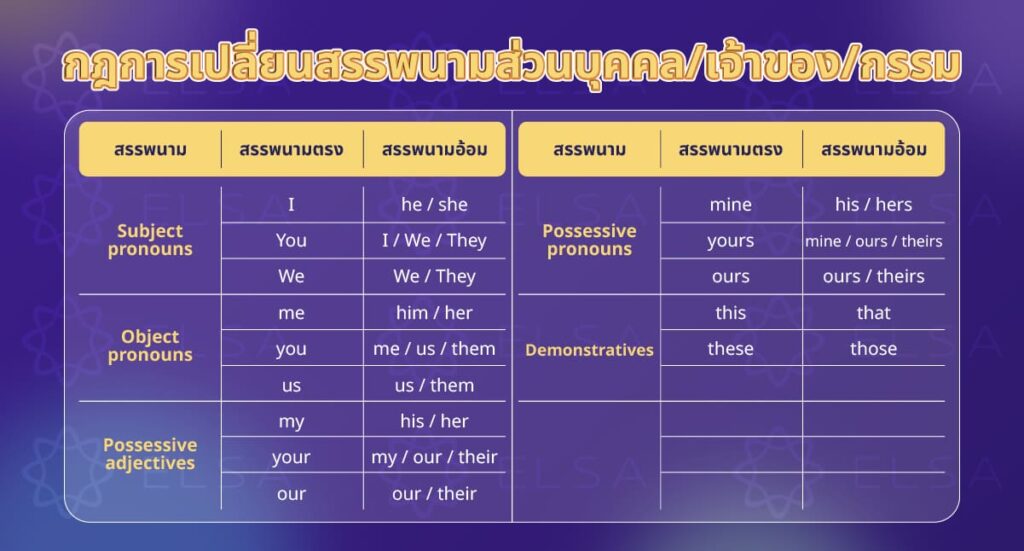
กฎการเปลี่ยนสรรพนามส่วนบุคคล/เจ้าของ/กรรม
หลังจากเปลี่ยนกาลแล้ว คุณต้องเปลี่ยนสรรพนามบุรุษ สรรพนามแสดงความเป็นเจ้าของ คำคุณศัพท์แสดงความเป็นเจ้าของ และกรรมให้เหมาะสมกับบริบทของประโยค วิธีการแปลงมีดังนี้:
| สรรพนาม | สรรพนามตรง | สรรพนามอ้อม |
|---|---|---|
| Subject pronouns | I | he / she |
| You | I / We / They | |
| We | We / They | |
| Object pronouns | me | him / her |
| you | me / us / them | |
| us | us / them | |
| Possessive adjectives | my | his / her |
| your | my / our / their | |
| our | our / their | |
| Possessive pronouns | mine | his / hers |
| yours | mine / ours / theirs | |
| ours | ours / theirs | |
| Demonstratives | this | that |
| these | those |
ตัวอย่าง:
- ประโยคบอกเล่าโดยตรง: “I am going to the store.” -> ประโยครายงาน: He/She said that he/she was going to the store.
- ประโยคบอกเล่าโดยตรง: “We have finished our project.” -> ประโยครายงาน: They said that they had finished their project.
>>> อ่านเพิ่มเติม:
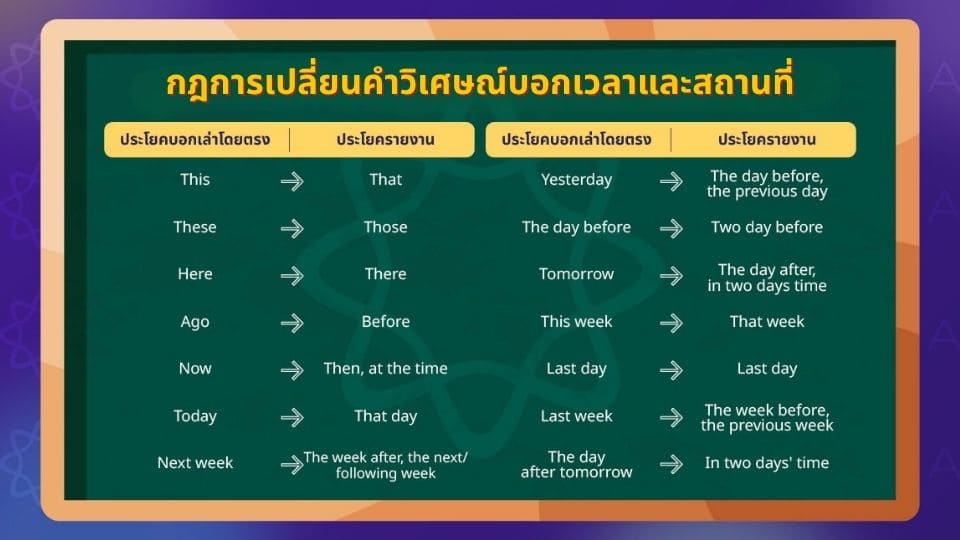
กฎการเปลี่ยนคำวิเศษณ์บอกเวลาและสถานที่
ด้านล่างนี้คือตารางคำศัพท์ที่ใช้กันทั่วไปในภาษาอังกฤษ ซึ่งใช้ระบุสถานที่และเวลา:
| ประโยคบอกเล่าโดยตรง | ประโยครายงาน |
|---|---|
| This | That |
| These | Those |
| Here | There |
| Ago | Before |
| Now | Then, at the time |
| Today | That day |
| Yesterday | The day before, the previous day |
| The day before | Two days before |
| Tomorrow | The day after, in two days time |
| This week | That week |
| Last day | The day before |
| Last week | The week before, the previous week |
| Next week | The week after, the next/following week |
| The day after tomorrow | In two days’ time |
ตัวอย่าง:
- ประโยคบอกเล่าโดยตรง: “I saw him today”, she said.
-> ประโยครายงาน: She said that she had seen him that day.
- ประโยคบอกเล่าโดยตรง: “I saw her a week ago,” he said.
-> ประโยครายงาน: He said he had seen her a week before.
ประเภทของประโยครายงาน
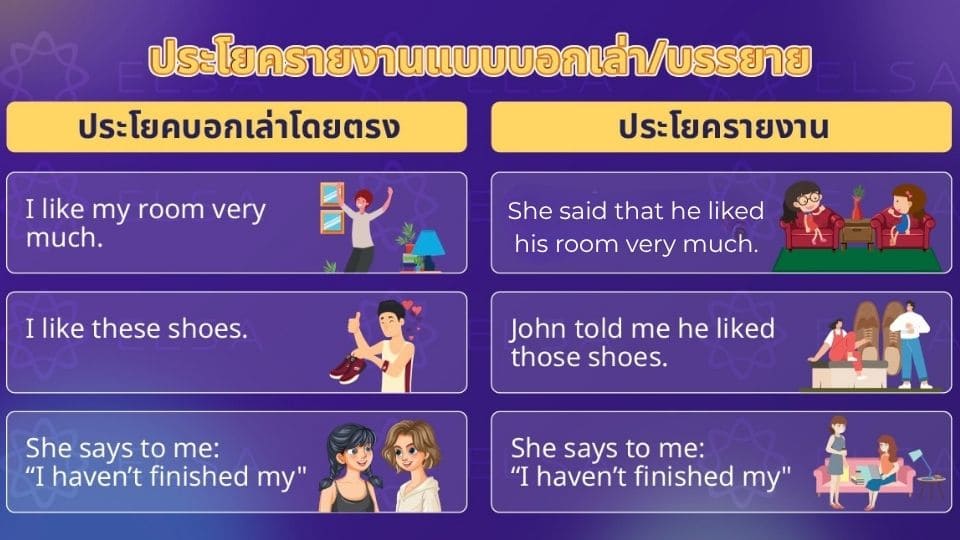
ประโยครายงานแบบบอกเล่า/บรรยาย
ของประโยครายงาน ในรูปแบบการเล่าเรื่อง ใช้เพื่อเล่าเนื้อหาของคำพูดหรือเรื่องราวที่บุคคลอื่นเคยเล่ามาก่อน สูตรโครงสร้างของ ของประโยครายงาน ในรูปแบบการเล่าเรื่องมีดังนี้:
โครงสร้างที่ 1:
| Subject + say/says/said หรือ tell/told + (that) + S + Verb |
ตัวอย่าง: She said, “I like my room very much” -> She said that she liked his room very much.
โครงสร้างที่ 2:
| Said to + O -> told + O |
ตัวอย่าง: John said to me: “I like these shoes” -> John told me he liked those shoes.
โครงสร้างที่ 3:
| Says/say to + O -> tells/tell + O |
ตัวอย่าง: She says to me: “I haven’t finished my housework” -> She tells me she hasn’t finished her housework.
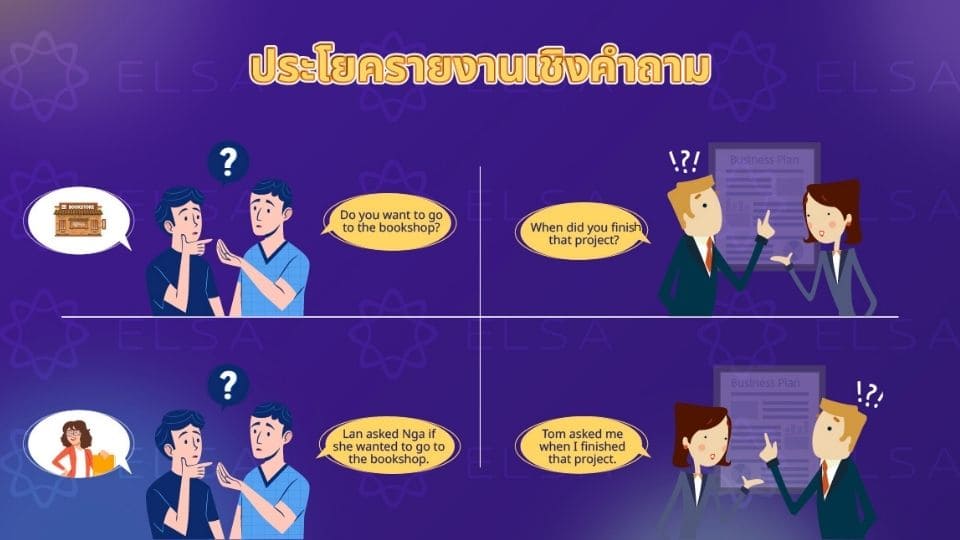
ประโยครายงานเชิงคำถาม
เมื่อเรารายงานคำถาม เราจะไม่คงรูปแบบคำถามเดิมไว้ แต่จะเปลี่ยนเป็นประโยคบอกเล่า โดยปรับกาล สรรพนาม และคำวิเศษณ์บอกเวลาและสถานที่ให้เหมาะสมกับบริบท
- Yes/No questions
Yes/No questions สามารถตอบได้ด้วย Yes หรือ No เมื่อแปลงเป็น ประโยครายงาน เรา ใช้ if หรือ whether และย้ายกริยาช่วยไปไว้ต้นประโยค
| S + asked / wanted to know / wondered + if / whether + S + V |
ตัวอย่าง:
ประโยคบอกเล่าโดยตรง: Lan asked Nga, “Do you want to go to the bookshop?”
-> ประโยครายงาน: Lan asked Nga if she wanted to go to the bookshop.
- Wh-questions
Wh-questions คือคำถามที่ขึ้นต้นด้วยคำถาม เช่น what, when, where, why, who, which, how… การรายงาน เราจะคงคำถามแบบ Wh-word แต่เปลี่ยนประโยคให้เป็นประโยคบอกเล่า
| S + asked (+ O) / wanted to know / wondered + Wh-word + S + V |
ตัวอย่าง:
ประโยคบอกเล่าโดยตรง: Tom asked me, “When did you finish that project?”
-> ประโยครายงาน: Tom asked me when I finished that project.
>>> อ่านเพิ่มเติม:
- If Clause ประโยคเงื่อนไข: โครงสร้าง วิธีใช้ แบบฝึกหัด และเคล็ดลับการท่องจำ
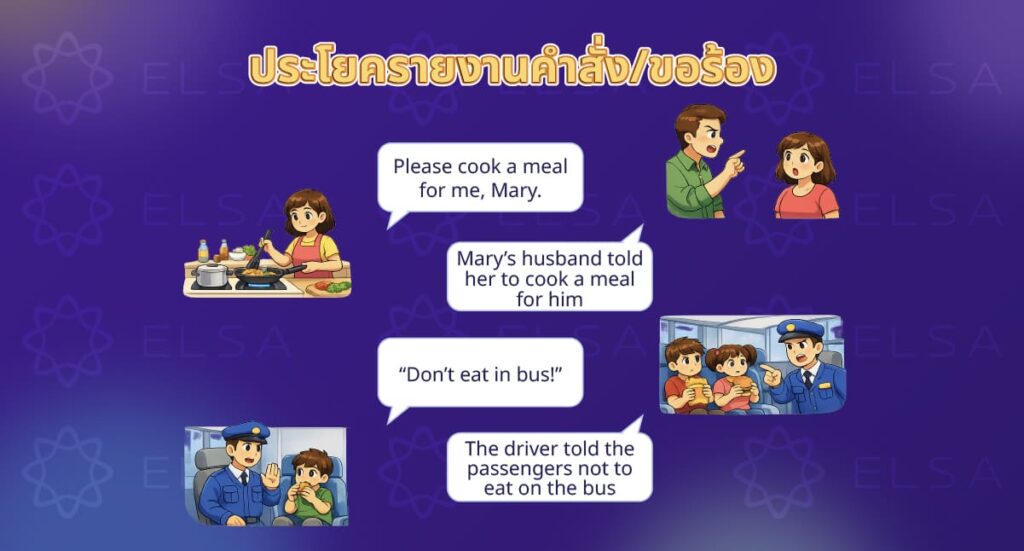
ประโยครายงานคำสั่ง/ขอร้อง
- โครงสร้าง ประโยครายงาน ในรูปแบบคำสั่งเชิงบวก:
| Subject + told + Object + to-infinitive |
ตัวอย่าง: “Please cook a meal for me, Mary.” Mary’s husband said. -> Mary’s husband told her to cook a meal for him.
- โครงสร้าง ประโยครายงาน ในรูปแบบของประโยคคำสั่งเชิงลบ:
| S + told + O + not to-infinitive |
ตัวอย่าง: “Don’t eat on the bus!” the driver said.” -> The driver told the passengers not to eat on the bus.
คำกริยาที่ใช้กันทั่วไปในการรายงานประโยคคำสั่ง เช่น tell, ask, order, advise, warn, beg, command, remind,…
โครงสร้างพิเศษขั้นสูง
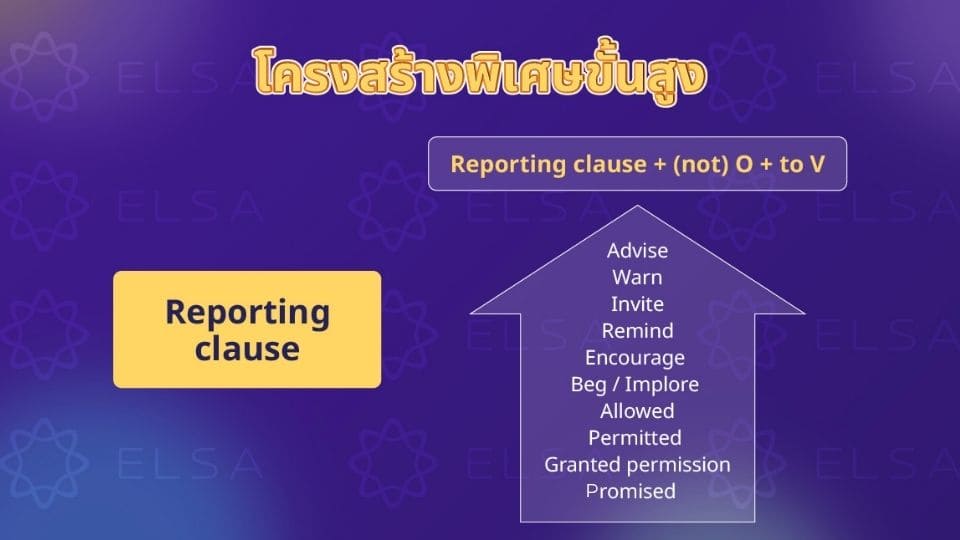
คำกริยาที่มี To-infinitive (V + O + to V)
ใน Reported Speechกลุ่มคำกริยานี้ใช้ในการรายงานคำแนะนำ คำเตือน คำเชิญ การเตือนความจำ หรือเพื่อโน้มน้าวการกระทำของผู้อื่น
ลักษณะทั่วไปของคำกริยาเหล่านี้คือ มีกรรม (O) เสมอ และคำกริยาที่ตามมาอยู่ในรูป to-infinitive โครงสร้างนี้ช่วย ประโยครายงาน แปลงคำสั่ง ข้อเสนอแนะ หรือคำแนะนำให้เป็นคำพูดทางอ้อมได้อย่างกระชับและเป็นธรรมชาติ
| ชื่อโครงสร้าง | โครงสร้าง | ตัวอย่าง |
|---|---|---|
| Advise (แนะนำ) | advised + O + to V | The doctor advised me to rest. |
| Warn (เตือน) | warned + O + not to V | She warned him not to be late. |
| Invite (เชิญ) | invited + O + to V | They invited us to join the party. |
| Beg / Implore (ขอร้อง) | begged / implored + O + to V | She begged him to forgive her. |
| Allowed/ Permitted/ Granted permission (อนุญาต) | allowed + O + to Vpermitted + O + to Vgranted permission to + V | He allowed me to use his laptop. |
| Promise (สัญญา) | promised + to V | He promised to help me with my homework. |
| Extended an invitation (คำเชิญ) | invited + O + to Vextended an invitation to + O + to V | She invited me to come to her party. |
| Reminded (เตือนความจำ) | reminded + O + (not) to V | The manager reminded me not to forget to submit my report by Friday. |
| Encouraged (ให้กำลังใจ) | encouraged + O + to V | My coach encouraged me not to give up and told me I could do it. |
| Motivated (กระตุ้น) | motivated + O + to V | Her coach motivated her to train harder. |
| Urged (เร่งเร้า) | urged + O + to V | The teacher urged the students to submit their homework on time. |
| Offered (เสนอความช่วยเหลือ) | offered + to V | He offered to help me with those bags. |
| Agreed (ตกลง) | agreed + to V | They agreed to meet at the café at 5 PM. |
| Refused (ปฏิเสธ) | refused + to V | He refused to answer any questions. |
| Declined (ปฏิเสธ) | declined + to V | She declined to attend the meeting. |
| Threatened (ข่มขู่) | threatened + to V | He threatened to call the police. |
>>> อ่านเพิ่มเติม: Infinitive คืออะไร โครงสร้างและการใช้ พร้อมแบบฝึกหัดด้วยตัวอย่าง
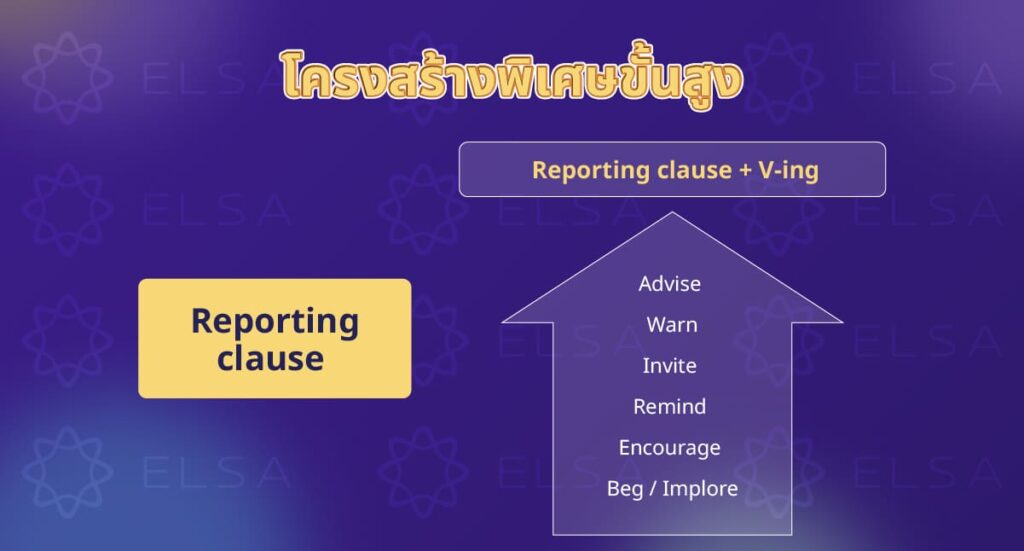
คำกริยาที่มี V-ing (Gerund)
ใน Reported Speech มีคำกริยาหลายคำที่ใช้กันทั่วไปเพื่ออธิบายการกระทำ ทัศนคติ หรือปฏิกิริยา (การแนะนำ การรับทราบ การปฏิเสธ การขอโทษ การกล่าวหา การขอบคุณ เป็นต้น)
ลักษณะทั่วไปของกลุ่มนี้คือ คำกริยาที่ตามมาจะอยู่ในรูป V-ing เสมอ ไม่ใช่รูป to V โครงสร้างนี้ทำให้ ประโยครายงาน กระชับ เป็นธรรมชาติ และเน้นที่การอธิบายพฤติกรรมมากกว่าการพูดซ้ำคำพูดที่ได้ยินมาตรงๆ
| ชื่อโครงสร้าง | โครงสร้าง | ตัวอย่าง |
|---|---|---|
| Suggest (แนะนำ) | suggested + V-ing | He suggested going out. |
| Admit (ยอมรับ) | admitted + V-ing | She admitted making a mistake. |
| Deny (ปฏิเสธ) | denied + V-ing | He denied stealing the money. |
| Apologize (ขอโทษ) | apologized + for + V-ing | She apologized for being late. |
| Accuse (กล่าวหา) | accused + O + of + V-ing | They accused him of cheating. |
| Insist on (ยืนยัน) | insisted on + V-ing | He insisted on paying the bill. |
| Thank (ขอบคุณ) | thanked + O + for + V-ing | She thanked me for helping her. |
| Charged (กล่าวหาว่าผิด) | accused + O + of + V-ing charged + O + with + V-ing | She accused him of stealing her wallet. |
| Blame (ตำหนิ) | blamed + O + for + V-ing | He blamed her for losing the game. |
| Confess (สารภาพ) | confessed + (to) + V-ing | He confessed to lying to his parents. |
| Praise (ชมเชย) | praised + O + for + V-ing | The teacher praised her for working hard. |
| Compliment (ยกย่อง) | complimented + O + on + V-ing | She complimented him on dressing well. |
| Congratulate (แสดงความยินดี) | congratulated + O + on + V-ing | They congratulated her on winning the prize. |
>>> อ่านเพิ่มเติม:
- หลักการเติม ing หลังคำกริยาในภาษาอังกฤษที่ควรรู้เพื่อการเรียน
- Gerund คือ อะไร? หลักการ วิธีการใช้งาน และแบบฝึกหัด
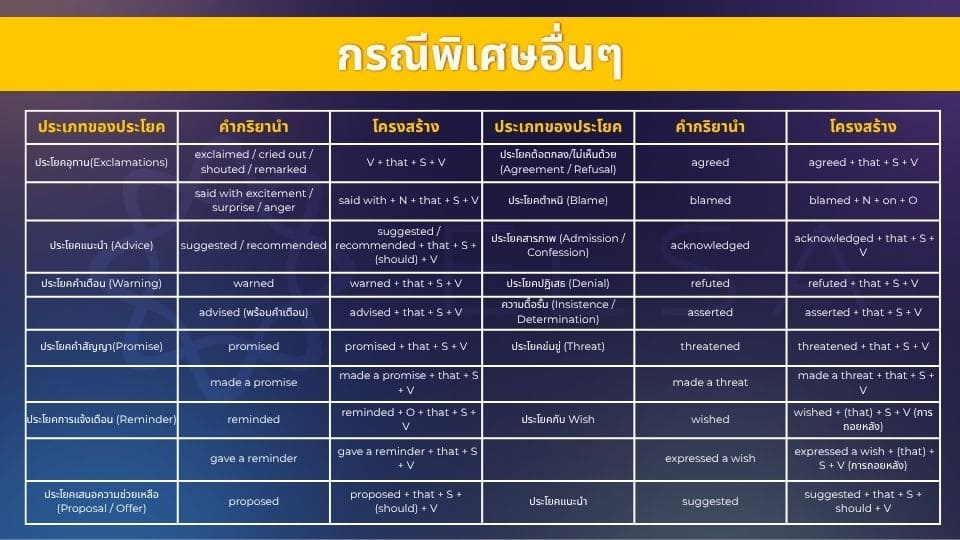
กรณีพิเศษอื่นๆ
ประโยคอุทาน (Exclamations)
| exclaimed that + S + V said with excitement / surprise / anger + that + S + V cried out / shouted / remarked + that + S + V |
ตัวอย่าง:
- ประโยคบอกเล่าโดยตรง: “What a beautiful view!” she said.
→ ประโยครายงาน: She exclaimed that it was a beautiful view.
ประโยคแนะนำ (Advice)
| suggested + that + S + (should) + V recommended + that + S + (should) + V |
ตัวอย่าง:
- ประโยคบอกเล่าโดยตรง: “We should start the meeting earlier,” he said.
→ ประโยครายงาน: He suggested that we (should) start the meeting earlier. (เขาเสนอให้เราเริ่มการประชุมเร็วกว่ากำหนด)
- ประโยคบอกเล่าโดยตรง: “You should take a short break,” the doctor said to her.
→ ประโยครายงาน: The doctor recommended that she (should) take a short break. (แพทย์แนะนำให้เธอพักผ่อนสักระยะหนึ่ง)
ประโยคคำเตือน (Warning)
| warned + that + S + V advised + that + S + V (เพื่อส่งสัญญาณเตือน) |
ตัวอย่าง:
- ประโยคบอกเล่าโดยตรง: “If you don’t wear a helmet, you will get hurt,” the policeman said.
→ ประโยครายงาน: The policeman warned that I would get hurt if I didn’t wear a helmet. (ตำรวจเตือนผมว่าผมอาจได้รับบาดเจ็บหากไม่สวมหมวกกันน็อก)
- ประโยคบอกเล่าโดยตรง: “You may lose your job if you keep coming late,” my boss said.
→ ประโยครายงาน: My boss advised that I might lose my job if I kept coming late. (เจ้านายเตือนฉันว่าฉันอาจจะถูกไล่ออกถ้ายังมาทำงานสายอีก)
ประโยคคำสัญญา (Promise)
| promised + that + S + V made a promise + that + S + V |
ตัวอย่าง:
- ประโยคบอกเล่าโดยตรง: “I will finish the report by tomorrow,” he said.
→ ประโยครายงาน: He promised that he would finish the report by the next day. (เขาสัญญาว่าจะเขียนรายงานให้เสร็จก่อนวันพรุ่งนี้)
- ประโยคบอกเล่าโดยตรง: “I won’t tell anyone your secret,” she said.
→ ประโยครายงาน: She made a promise that she wouldn’t tell anyone my secret. (เธอสัญญาว่าจะไม่บอกความลับของฉันให้ใครรู้)
ประโยคการแจ้งเตือน (Reminder)
| reminded + O + that + S + V gave a reminder + that + S + V |
ตัวอย่าง:
- ประโยคบอกเล่าโดยตรง: “Don’t forget to lock the door,” my mother said to me.
→ ประโยครายงาน: My mother reminded me that I had to lock the door. (แม่เตือนฉันว่าต้องล็อกประตู)
- ประโยคบอกเล่าโดยตรง: “The meeting starts at 9 a.m.,” the manager said.
→ ประโยครายงาน: The manager gave a reminder that the meeting started at 9 a.m. (ผู้จัดการเตือนทุกคนว่าการประชุมจะเริ่มเวลา 9 โมงเช้า)
ประโยคเสนอความช่วยเหลือ (Offer)
| proposed + that + S + (should) + V |
ตัวอย่าง:
- ประโยคบอกเล่าโดยตรง: “We should delay the project until next month,” the manager said.
→ ประโยครายงาน: The manager proposed that the project (should) be delayed until the following month. (ผู้จัดการเสนอว่าควรเลื่อนโครงการไปเป็นเดือนหน้า)
ประโยคตกลง/ไม่เห็นด้วย (Agreement / Refusal)
| agreed + that + S + V |
ตัวอย่าง:
- ประโยคบอกเล่าโดยตรง: “We will finish the project by Friday,” they said.
→ ประโยครายงาน: They agreed that they would finish the project by Friday. (พวกเขาตกลงกันว่าจะทำโครงการให้เสร็จก่อนวันศุกร์)
ประโยคตำหนิ (Blame)
| blamed + N + on + O |
ตัวอย่าง:
- ประโยคบอกเล่าโดยตรง: “The accident happened because of his carelessness,” the manager said.
→ประโยครายงาน: The manager blamed the accident on his carelessness. (ผู้จัดการตำหนิว่าอุบัติเหตุเกิดจากความประมาทของตนเอง)
ประโยคสารภาพ(Admission / Confession)
| acknowledged + that + S + V |
ตัวอย่าง:
- ประโยคบอกเล่าโดยตรง: “I made a mistake in the report,” he said.
→ประโยครายงาน: He acknowledged that he had made a mistake in the report. (เขาสารภาพว่าเขาทำรายงานฉบับนั้นผิดพลาด)
ประโยคปฏิเสธ (Denial)
| refuted + that + S + V |
ตัวอย่าง:
- ประโยคบอกเล่าโดยตรง: “The report is completely false,” the spokesman said.
→ประโยครายงาน: The spokesman refuted that the report was true. (โฆษกปฏิเสธว่ารายงานดังกล่าวไม่ถูกต้อง)
ความดื้อรั้น (Insistence / Determination)
| asserted + that + S + V |
ตัวอย่าง:
- ประโยคบอกเล่าโดยตรง: “I did not break the rules,” he said firmly.
→ ประโยครายงาน: He asserted that he had not broken the rules.(เขายืนยันว่าเขาไม่ได้ละเมิดกฎระเบียบใดๆ)
ประโยคข่มขู่ (Threat)
| threatened + that + S + V made a threat + that + S + V |
ตัวอย่าง:
- ประโยคบอกเล่าโดยตรง: “I will cancel the contract if you don’t cooperate,” the manager said.
→ประโยครายงาน: The manager threatened that he would cancel the contract if they didn’t cooperate. (ผู้จัดการขู่ว่าจะยกเลิกสัญญาหากพวกเขาไม่ให้ความร่วมมือ)
ประโยคกับ wish
| wished + (that) + S + V (เปลี่ยนกริยาให้เป็นอดีต) expressed a wish + (that) + S + V (แปลงกาล) |
ตัวอย่าง:
- ประโยคบอกเล่าโดยตรง: “I wish I were taller,” she said.
-> ประโยครายงาน: She wished she were taller. (เธอปรารถนาว่าตัวเองจะสูงกว่านี้)
ประโยคกับ let
| Let + O + V → told/asked + O + to V Let’s + V → suggested + V-ing / suggested that + S + should + V |
ตัวอย่าง:
- ประโยคบอกเล่าโดยตรง: “Let him go!” she said.
-> ประโยครายงาน: She told him to let him go. (เธอบอกให้ปล่อยเขาไป)
กรณีที่ไม่มีการเปลี่ยนกาล
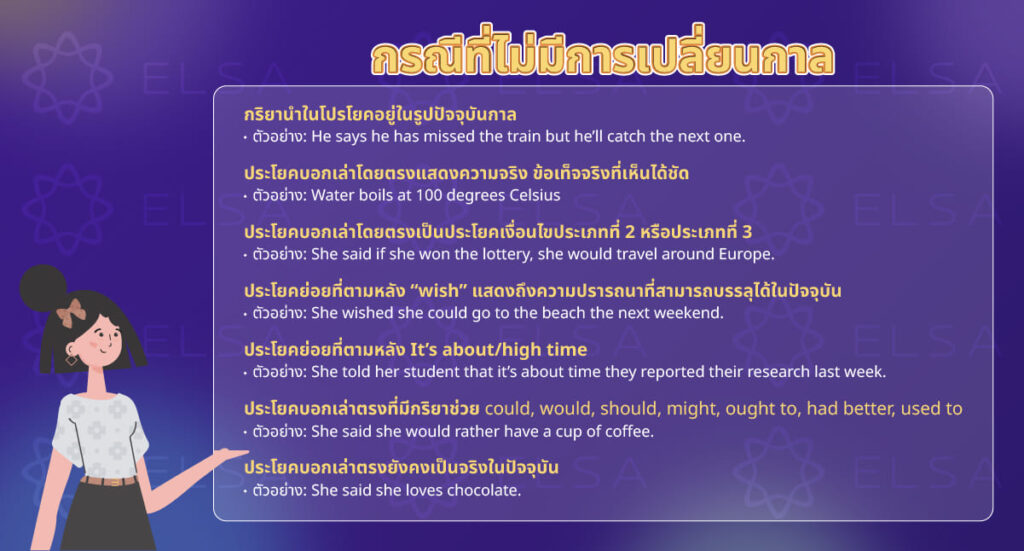
กรณีที่ไม่มีการเปลี่ยนกาลในประโยครายงาน
เมื่อแปลงจากประโยคบอกเล่าโดยตรงเป็นประโยครายงาน คุณไม่จำเป็นต้องเปลี่ยนกาลของคำกริยาในกรณีต่อไปนี้:
- กริยานำในประโยคอยู่ในรูปปัจจุบันกาล
คุณไม่จำเป็นต้องเปลี่ยนกาลในประโยคที่ใช้กริยานำในปัจจุบันกาล หรือเมื่อประโยคเดิมกล่าวถึงข้อเท็จจริงในปัจจุบัน
ตัวอย่าง: He says he has missed the train but he’ll catch the next one. (เขาบอกว่าเขาพลาดรถไฟไปแล้ว แต่เขาจะขึ้นรถไฟขบวนถัดไป)
- ประโยคบอกเล่าโดยตรง แสดงความจริงหรือข้อเท็จจริงที่เห็นได้ชัด
ตัวอย่าง: Water boils at 100 degrees Celsius. (น้ำเดือดที่อุณหภูมิ 100 องศาเซลเซียส)
- ประโยคบอกเล่าโดยตรงเป็นประโยคเงื่อนไขประเภทที่ 2 หรือประเภทที่ 3
ตัวอย่าง: She said if she won the lottery, she would travel around Europe. (เธอบอกว่าถ้าเธอถูกหวย เธอจะเดินทางเที่ยวไปทั่วยุโรป)
- ประโยคย่อยที่ตามหลัง “wish” แสดงถึงความปรารถนาที่สามารถบรรลุได้ในปัจจุบัน
กาลของประโยคย่อยจะไม่เปลี่ยนแปลงเมื่อประโยคย่อยที่ตามหลัง “wish” แสดงถึงความปรารถนาที่สามารถบรรลุได้ในปัจจุบัน
ตัวอย่าง: She wished she could go to the beach the next weekend. (เธอหวังว่าเธอจะได้ไปทะเลในสุดสัปดาห์หน้า)
- ประโยคย่อยที่ตามหลัง It’s about/high time
กาลของประโยคย่อยที่ตามหลัง “It’s about/high time” ยังคงไม่เปลี่ยนแปลง
ตัวอย่าง: She told her student that it’s about time they reported their research last week. (ครูบอกนักเรียนว่าถึงเวลาแล้วที่จะต้องรายงานผลการวิจัยเมื่อสัปดาห์ที่แล้ว)
- ประโยคบอกเล่าตรงที่มีกริยาช่วย เช่น COULD, WOULD, SHOULD, MIGHT, OUGHT TO, HAD BETTER, USED TO.
ตัวอย่าง: She said she would rather have a cup of coffee. (เธอบอกว่าเธออยากดื่มกาแฟสักแก้ว)
- ประโยคบอกเล่าที่ยังคงเป็นจริงในปัจจุบัน
กาลจะไม่เปลี่ยนเมื่อเนื้อหาของประโยคตรงยังคงเป็นจริงในขณะที่รายงาน แม้ว่ากริยาที่ใช้ในการรายงานจะเป็นกาลอดีตก็ตาม โดยปกติจะใช้กับความชอบ นิสัย หรือข้อเท็จจริงส่วนบุคคลที่ไม่เปลี่ยนแปลง
ตัวอย่าง: She said she loves chocolate. (เธอบอกว่าเธอชอบช็อกโกแลต)
ความแตกต่างระหว่างประโยคบอกเล่า (Declarative sentences) และประโยครายงาน (Reported speech)
เพื่อหลีกเลี่ยงความสับสน คุณต้องเข้าใจความแตกต่างระหว่างประโยคบอกเล่า (declarative sentences) และประโยครายงาน (reported speech) ตารางด้านล่างจะช่วยให้คุณเปรียบเทียบวัตถุประสงค์ รูปแบบ และตัวอย่างของประโยคทั้งสองประเภทนี้ได้อย่างชัดเจน:
| ลักษณะเฉพาะ | ประโยคบอกเล่า (Declarative sentences) | ประโยครายงาน (Reported speech) |
|---|---|---|
| วัตถุประสงค์ | เพื่อกล่าวถึงข้อมูล ข้อเท็จจริง ความคิดเห็น หรือคำอธิบาย | เพื่อเล่าคำพูดหรือความคิดของผู้อื่นโดยคงความหมายเดิมไว้ |
| รูปแบบ | ใช้ลำดับประธาน-กริยา ไม่มีเครื่องหมายอัญประกาศ ไม่มีการสลับตำแหน่งคำ จบด้วยจุด | มีกริยาบอกเล่า (say, tell, ask…). สามารถเปลี่ยนกาล เปลี่ยนสรรพนาม เวลา และสถานที่ได้ ไม่ใช้เครื่องหมายอัญประกาศ |
| ตัวอย่าง | The sun rises in the east. (ดวงอาทิตย์ขึ้นทางทิศตะวันออก) The house was built in 1990. (บ้านหลังนี้สร้างขึ้นในปี 1990) We took a taxi because it was raining heavily. (เรานั่งแท็กซี่เพราะฝนตกหนัก) | “I will call you tomorrow,” Tom said. → Tom said (that) he would call me the next day. (ทอมบอกว่าเขาจะโทรหาฉันในวันพรุ่งนี้) “Where do you live?” he asked. → He asked where I lived. (เขาถามว่าฉันอาศัยอยู่ที่ไหน) |
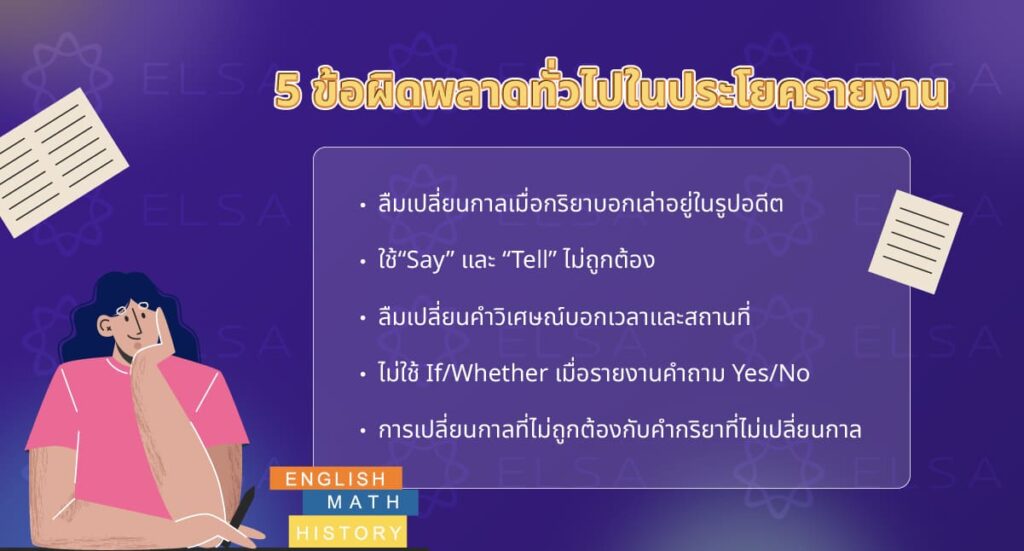
ข้อผิดพลาดทั่วไป
ในการเรียน ประโยครายงาน (Reported Speech) หลายคนมักทำผิดพลาดเนื่องจากไม่เข้าใจกฎการเปลี่ยนกาล การใช้กริยาบอกเล่าไม่ถูกต้อง หรือลืมเปลี่ยนคำวิเศษณ์บอกเวลาและสถานที่ ด้านล่างนี้คือข้อผิดพลาดที่พบบ่อยที่สุดใน ประโยครายงาน และวิธีหลีกเลี่ยงเพื่อให้ใช้ไวยากรณ์ภาษาอังกฤษได้อย่างถูกต้อง
1. ลืมเปลี่ยนกาลเมื่อกริยาบอกเล่าอยู่ในรูปอดีต
หนึ่งในข้อผิดพลาดที่พบบ่อยที่สุดใน ประโยครายงาน คือการไม่เปลี่ยนกาลของกริยาหลักเมื่อกริยาบอกเล่าอยู่ในรูปอดีต (said, told, asked…)
2. ใช้“Say” และ “Tell” ไม่ถูกต้องใน ประโยครายงาน
การใช้คำว่า say และ tell สลับกันเป็นความผิดพลาดที่พบได้บ่อยมากในการเขียน ประโยครายงาน เพื่อแยกแยะความแตกต่างระหว่าง say และ tell:
- Say: ไม่ต้องมีกรรมโดยตรง → say + (that) + ประโยคย่อย
- Tell: ต้องมีกรรม → tell + O + (that) + ประโยคย่อย
ตัวอย่าง:
- She said that she was tired.
- She told me that she was tired.
เกี่ยวกับโครงสร้างทั่วไป
| คำกริยา | โครงสร้างที่ใช้บ่อย |
|---|---|
| say | say (that) + clause |
| say | say + something + to + someone |
| tell | tell + someone + (that) + clause |
ตัวอย่าง:
- He said that he was busy.
- He said hello to everyone.
- He told us that he was busy.
เกี่ยวกับการใช้งาน
- Say: เน้นเนื้อหาของคำพูด ไม่ค่อยสนใจผู้ฟัง
- Tell: เน้นบุคคลที่กำลังฟังอยู่และให้ข้อมูล
3. ลืมเปลี่ยนคำวิเศษณ์บอกเวลาและสถานที่
เมื่อเปลี่ยนเป็นประโยครายงาน คำวิเศษณ์บอกเวลาและสถานที่ต้องเปลี่ยนให้เหมาะสมกับบริบท แต่ผู้เรียนมักมองข้ามขั้นตอนนี้
4. ไม่ใช้ If/Whether เมื่อรายงานคำถาม Yes/No
สำหรับคำถาม Yes/No ประโยครายงาน จำเป็นต้องใช้ if หรือ whether แต่หลายคนยังคงใช้โครงสร้างคำถามแบบตรง
5.การเปลี่ยนกาลที่ไม่ถูกต้องกับคำกริยาที่ไม่เปลี่ยนกาลในประโยครายงาน
คำกริยาพิเศษบางคำใน Reported Speech ไม่จำเป็นต้องเปลี่ยนกาล แต่ผู้เรียนมักเปลี่ยนกาลผิดพลาด คำกริยาที่โดยปกติไม่เปลี่ยนแปลง ได้แก่ would, could, might, should, ought to.
แบบฝึกหัด
แบบฝึกหัดที่ 1: แปลงประโยคต่อไปนี้ให้เป็น ประโยครายงาน อย่างถูกต้อง
- She said, “I like this film.”
……………………………………………………………………… - “Where is your brother?” he asked me.
……………………………………………………………………… - “I don’t speak Chinese,” she said.
……………………………………………………………………… - “Say hello to Matt,” they said.
……………………………………………………………………… - “The movie began at 8 o’clock,” she said.
………………………………………………………………………
เฉลย
| ข้อ | เฉลย | อธิบาย |
|---|---|---|
| ข้อ | เฉลย | อธิบาย |
| 1 | She said she liked that film. | เปลี่ยนกาลปัจจุบันกลับไปเป็นกาลอดีต; this → that. |
| 2 | He asked me where my brother was. | คำถาม Wh- → ลำดับบอกเล่า; is → was. |
| 3 | She said that she didn’t speak Chinese. | ปัจจุบันกาลปฏิเสธแบบง่าย → อดีตกาลปฏิเสธแบบง่าย |
| 4 | They asked me to say hello to Matt. | ประโยคคำสั่ง → asked + O + to V. |
| 5 | She said that the movie had begun at 8 o’clock. | กาลอดีตธรรมดา → กาลอดีตสมบูรณ์ |
แบบฝึกหัดที่ 2: เขียนประโยคใหม่โดยใช้โครงสร้างที่เหมาะสม
- “I broke the vase,” she said.
- “Let’s go to the movies tonight,” he said.
- “You broke the window,” she said to me.
- “Don’t forget to call me later,” he said.
- “Please, lend me some money,” he said.
เฉลย
| เฉลย | อธิบาย | |
|---|---|---|
| 1 | She admitted breaking the vase. | Admit + V-ing. |
| 2 | He suggested going to the movies that night. | Suggest + V-ing; tonight → that night. |
| 3 | She accused me of breaking the window. | Accuse + O + of + V-ing. |
| 4 | He reminded me to call him later. | Remind + O + to V. |
| 5 | He begged me to lend him some money. | Beg + O + to V. |
แบบฝึกหัดที่ 3: เลือกคำตอบที่ถูกต้องเพื่อเติมเต็มประโยครายงาน
- “I am tired now,” she said.
She said that she _____ tired then.
A. is
B. was
C. has been
D. will be - “Where are you going?” he asked me.
He asked me where _____ going.
A. am I
B. I am
C. I was
D. was I - “Do you like coffee?” Tom asked Mary.
Tom asked Mary _____ coffee.
A. if she likes
B. if she liked
C. does she like
D. whether did she like - “I can’t swim,” the boy said.
The boy said that he _____ swim.
A. can’t
B. doesn’t
C. won’t
D. couldn’t - “Don’t touch the wire,” the teacher said to the students.
The teacher warned the students _____ the wire.
A. don’t touch
B. not touching
C. not to touch
D. to not touch - “How long have you lived here?” she asked him.
She asked him how long he _____ there.
A. has lived
B. had lived
C. did he live
D. he has lived - “I will call you tomorrow,” he said to me.
He told me that he _____ me the next day.
A. will call
B. calls
C. would call
D. called - “Let’s go out for dinner,” she said.
She suggested _____ out for dinner.
A. to go
B. going
C. go
D. went - “You broke my phone,” she said to him.
She accused him _____ her phone.
A. to break
B. of breaking
C. breaking
D. to have broken - “Please help me with this exercise,” the student said to the teacher.
The student asked the teacher _____ with the exercise.
A. to help
B. help
C. if he helped
D. helping
เฉลย
| B | C | B | D | C |
| B | C | B | B | A |
คำถามที่พบบ่อย
reported speech คืออะไร?
Indirect Speech/Reported Speech) เป็นวิธีการเล่าคำพูดของผู้อื่นโดยไม่ต้องใช้เครื่องหมายอัญประกาศ
สรุป reported speech
Reported speech เป็นการแปลงคำพูดตรงให้เป็นคำพูดอ้อมโดยการเปลี่ยนกาล เปลี่ยนสรรพนาม และปรับเปลี่ยนเวลาและสถานที่ให้เหมาะสม
reported statements คือ?
reported statements คือ (Reported Speech) เป็นประโยคใช้เพื่อเล่าสิ่งที่คนอื่นพูด ถาม หรือสั่ง
indirect speech ตัวอย่างประโยค
Direct: “I am tired,” she said.
-> Indirect: She said (that) she was tired.
said ใช้ยังไง
Said ไม่ไปกับกรรมโดยตรง โครงสร้าง said + (that) + อนุประโยค. ตัวอย่าง: He said (that) he was busy.
direct speech คือ
Direct Speech คือการนำคำพูดของผู้อื่นมากล่าวซ้ำตามตัวอักษรและใส่เครื่องหมายอัญประกาศไว้
Direct กับ indirect ต่างกันยังไง?
- ประโยคบอกเล่าโดยตรง: คงประโยคไว้เหมือนเดิม ยกเว้นวงเล็บ
- ประโยครายงาน: เล่าเรื่องโดยไม่ใส่เครื่องหมายอัญประกาศ อาจมีการเปลี่ยนกาลเวลาได้

ELSA Premium 1 ปี
8,497 บาท ->1,999 บาท
ELSA Premium ตลอดชีพ
9,999 บาท ->4,699 บาท
ขอให้คุณเรียนภาษาอังกฤษอย่างสนุกและมีประสิทธิภาพมากขึ้นทุกวันกับ ELSA Speak นะ!