

การฝึกทำ relative clause exercise เป็นวิธีที่มีประสิทธิภาพในการเสริมสร้างความเข้าใจเกี่ยวกับคำสรรพนามสัมพันธ์และกริยาวิเศษณ์เชื่อมประโยค รวมถึงช่วยให้คุณเชี่ยวชาญเทคนิคการลดรูป Relative Clause ในภาษาอังกฤษ มาร่วมสำรวจชุดแบบฝึกหัด relative clause ที่ครบถ้วนพร้อมคำอธิบายอย่างละเอียดได้ในบทความด้านล่างนี้กับแอปพลิเคชันฝึกภาษาอังกฤษ ELSA Speak นะ!
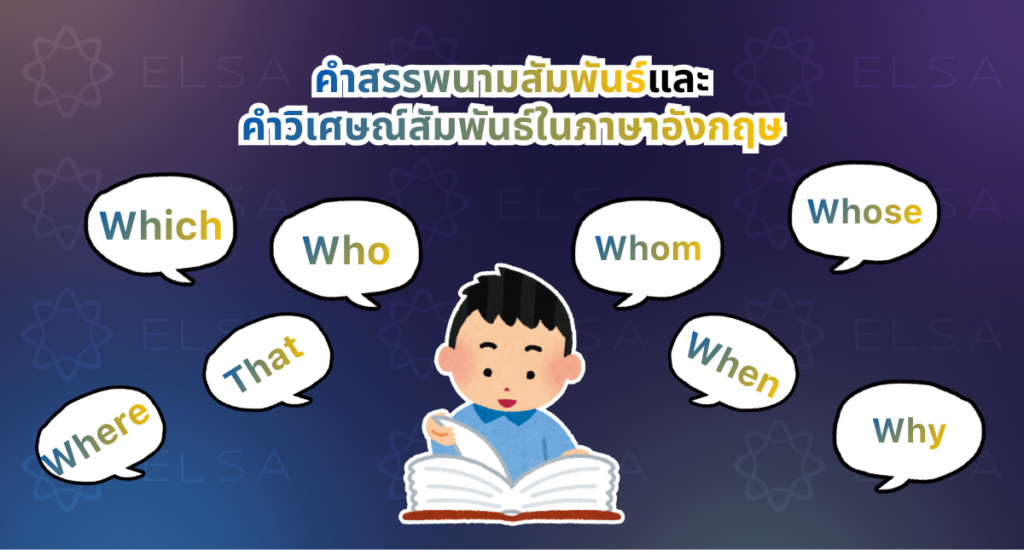
- ก่อนทํา relative clause exercise ควรจำว่า สรรพนาม who และ whom ใช้สำหรับคน which ใช้สำหรับสิ่งของ that สามารถใช้ได้ทั้งกับคนและสิ่งของอย่างยืดหยุ่น
- อนุประโยคสัมพันธ์แบบไม่เจาะจงจะคั่นด้วยเครื่องหมายจุลภาค และจะไม่ใช้สรรพนาม that อย่างเด็ดขาด
- สามารถย้ายคำบุพบทไปไว้หน้า whom หรือ which ได้
- อนุประโยคสัมพันธ์แบบย่อใช้ V-ing สำหรับประโยคประธานกระทำ V3 สำหรับประโยคกรรม และ to V สำหรับลำดับที่
สรุปทฤษฎีเกี่ยวกับอนุประโยคสัมพันธ์ (Relative Clauses)
อนุประโยคสัมพันธ์ คืออนุประโยคที่ตามหลังคำนามหรือคำสรรพนามเพื่ออธิบาย ขยายความ หรือขยายคำนามหรือคำสรรพนามนั้น ก่อนที่จะทำแบบฝึกหัด relative clause หรือ ข้อสอบ relative clause คุณต้องเข้าใจแนวคิดหลักต่อไปนี้ให้ถ่องแท้
สอบก่อนเข้าฟรี

ตารางแสดงคำสรรพนามสัมพันธ์และคำวิเศษณ์สัมพันธ์ที่ใช้กันทั่วไป
สรรพนามและคำวิเศษณ์สัมพันธ์แต่ละคำมีบทบาททางไวยากรณ์ที่แตกต่างกันไป ขึ้นอยู่กับคำนามที่อยู่ข้างหน้าและคำที่ตามมา ตารางสรุปด้านล่างนี้จะช่วยให้คุณทบทวนก่อนทำ relative clause ข้อสอบ ได้อย่างรวดเร็ว:
ลองอ่านออกเสียง 39 รายการนี้ดู แล้วดูคะแนนของคุณ
| คำเชื่อมสัมพันธ์ | ตำแหน่งในอนุประโยครอง | ตัวอย่างประกอบ |
| Who | ประธานหรือกรรมที่ใช้แทนคำนามที่อ้างถึงบุคคล | The girl who lives next door is very kind. (เด็กหญิงที่อยู่บ้านข้าง ๆ ใจดีมาก) |
| Whom | กรรม (ตามด้วย ประธาน + กริยา) ที่ใช้แทนคำนามที่อ้างถึงบุคคล | The man whom you met yesterday is my teacher. (ผู้ชายที่คุณพบเมื่อวานนี้คือครูของฉัน) |
| Which | ประธานหรือกรรมที่ใช้แทนคำนามที่อ้างถึงสิ่งของ วัตถุ หรือสัตว์ | The book which is on the desk is mine. (หนังสือบนโต๊ะเป็นของฉัน) |
| That | ใช้แทน who, whom หรือ which ในอนุประโยคแบบเจาะจง ซึ่งใช้แทนคำนามที่อ้างถึงทั้งคนและสิ่งของ | This is the laptop that I bought last week. (นี่คือแล็ปท็อปที่ฉันซื้อเมื่อสัปดาห์ที่แล้ว) |
| Whose | อยู่หน้าคำนามแสดงความเป็นเจ้าของที่ใช้แทนคำนามแสดงความเป็นเจ้าของอีกคำหนึ่ง (ซึ่งหมายถึงบุคคล/สิ่งของ) | The boy whose bicycle was stolen is crying. (เด็กชายที่มีจักรยานถูกขโมยกำลังร้องไห้) |
| Where | วลีวิเศษณ์บอกสถานที่ ซึ่งใช้แทนคำนามที่บ่งบอกสถานที่หรือตำแหน่ง | That is the school where I studied. (นั่นคือโรงเรียนที่ฉันเคยเรียน) |
| When | วลีวิเศษณ์บอกเวลา ซึ่งใช้แทนคำนามที่บ่งบอกเวลาหรือช่วงเวลา | I remember the day when we first met. (ฉันจำวันที่เราพบกันครั้งแรกได้) |
| Why | อยู่หลังคำนาม the reason ซึ่งใช้แทนคำนามที่บ่งบอกสาเหตุหรือเหตุผล | Tell me the reason why you were late. (บอกฉันหน่อยว่าทำไมคุณถึงมาสาย) |
แยกแยะความแตกต่างระหว่างอนุประโยคสัมพันธ์แบบเจาะจงและอนุประโยคสัมพันธ์แบบไม่เจาะจง
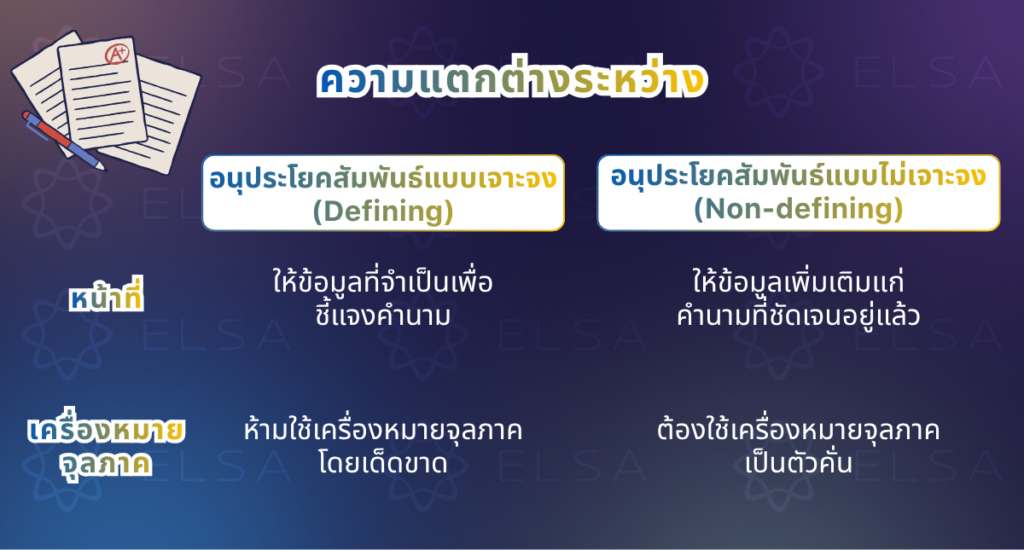
การแยกแยะความแตกต่างระหว่างอนุประโยคสองประเภทนี้อย่างถูกต้องจะช่วยให้คุณใช้เครื่องหมายจุลภาคได้อย่างแม่นยำและหลีกเลี่ยงข้อผิดพลาดในการใช้สรรพนาม “that” อย่างไม่ถูกต้อง ตารางเปรียบเทียบโดยละเอียดระหว่างอนุประโยคสัมพันธ์ทั้งสองประเภทมีดังต่อไปนี้:
| เกณฑ์การเปรียบเทียบ | อนุประโยคสัมพันธ์แบบเจาะจง (Defining) | อนุประโยคสัมพันธ์แบบไม่เจาะจง (Non-defining) |
| หน้าที่ | ให้ข้อมูลที่จำเป็นเพื่อชี้แจงคำนาม | ให้ข้อมูลเพิ่มเติมแก่คำนามที่ชัดเจนอยู่แล้ว |
| เครื่องหมายจุลภาค | ห้ามใช้เครื่องหมายจุลภาคโดยเด็ดขาด | ต้องใช้เครื่องหมายจุลภาคเป็นตัวคั่น |
| สรรพนาม that | สามารถใช้แทน who, whom หรือ which ได้ | ห้ามใช้สรรพนาม “that” เด็ดขาด |
| การละสรรพนาม | สามารถละเว้นได้เมื่อใช้เป็นกรรม | ห้ามละเว้นคำสรรพนามสัมพันธ์ |
| ตัวอย่าง | The woman who called you is my aunt. (ผู้หญิงที่โทรหาคุณคือป้าของฉัน) | My mother, who is 50 years old, is a doctor. (แม่ของฉัน ซึ่งมีอายุ 50 ปี เป็นหมอ) |
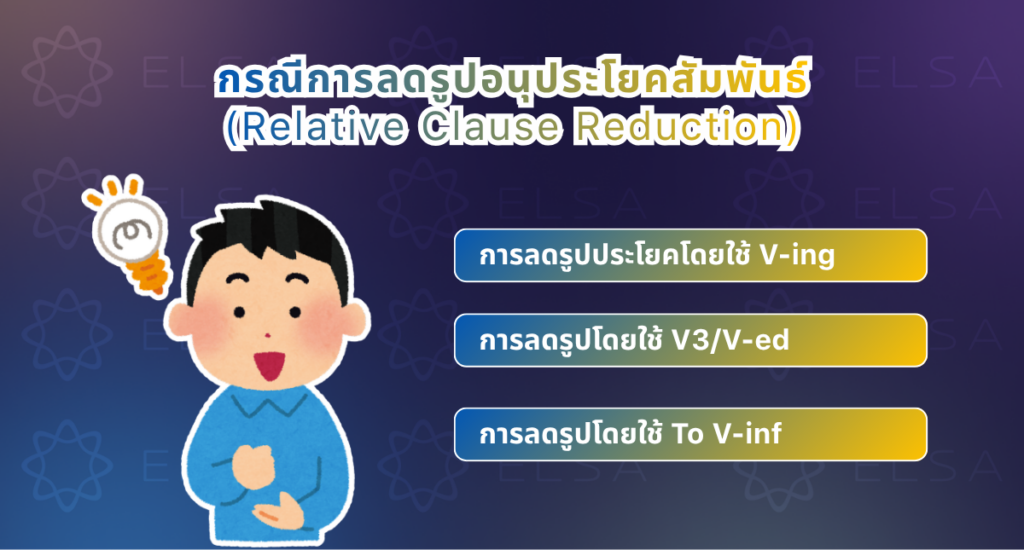
กรณีการลดรูปอนุประโยคสัมพันธ์ (Relative Clause Reduction)
การลดรูปอนุประโยคขยายสัมพันธ์เป็นแบบฝึกหัดระดับสูงที่พบได้บ่อยในการสอบภาษาอังกฤษ ต่อไปนี้คือกรณีที่พบบ่อย 3 รูปแบบของการลดรูปอนุประโยคขยายสัมพันธ์:
- การลดรูปประโยคโดยใช้ V-ing (เมื่อคำกริยามีความหมายเชิงกระทำ): ให้ตัดคำสรรพนามสัมพันธ์และกริยาช่วย “to be” ออก แล้วเปลี่ยนคำกริยาหลักให้เป็นรูป V-ing
- ตัวอย่าง: The man who is standing there. → The man standing there.
- การลดรูปโดยใช้ V3/V-ed (เมื่อคำกริยามีความหมายในเชิงถูกกระทำ): ให้ตัดคำสรรพนามสัมพันธ์และคำว่า “to be” ออก แล้วคงรูป Past Participle (V3/V-ed) ไว้
- ตัวอย่าง: The bridge which was built in 1990. → The bridge built in 1990.
- ลดรูปโดยใช้ To V-inf: หลักการนี้ใช้ในกรณีที่คำนามข้างหน้ามีคำขยาย เช่น the first, the second, the last หรือ the only กำกับอยู่ หรือเป็นคำนามในรูปขั้นสูงสุด
- ตัวอย่าง: He was the last person who left the room. → He was the last person to leave the room.
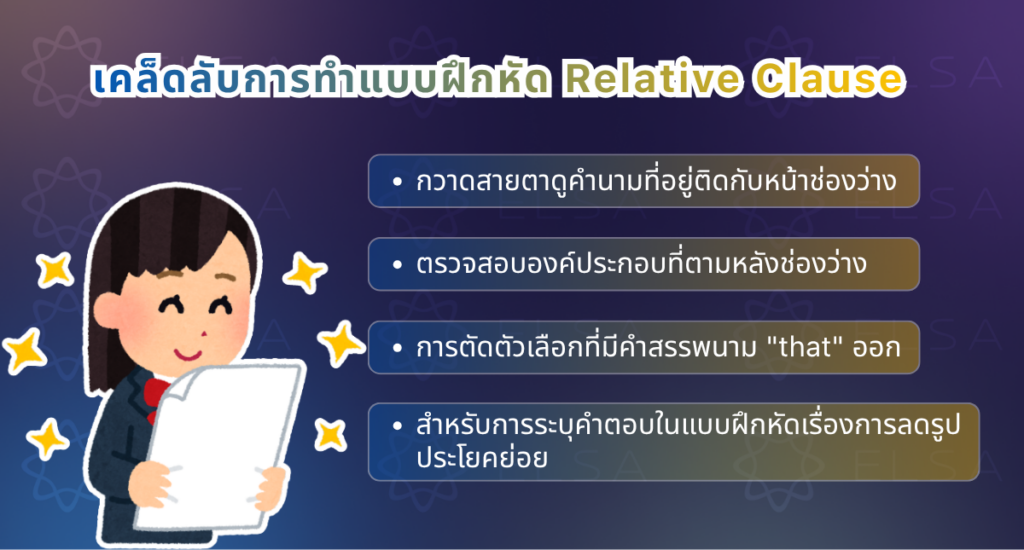
เคล็ดลับการทำแบบฝึกหัด Relative Clause ให้รวดเร็วและแม่นยำ
เพื่อหลีกเลี่ยงความสับสนเมื่อเจอคำถามแบบปรนัยที่มีความซับซ้อน คุณสามารถนำเคล็ดลับต่อไปนี้ไปใช้ในการกวาดสายตาหาเบาะแสทางไวยากรณ์ได้อย่างรวดเร็ว:
- กวาดสายตาดูคำนามที่อยู่หน้าช่องว่าง: พิจารณาว่าคำนามนั้นหมายถึงบุคคลหรือสิ่งของ หากเป็นบุคคล ให้เลือกใช้ who, whom หรือ whose แต่หากเป็นสิ่งของ ให้เลือกใช้ which หรือ that
- ตรวจสอบองค์ประกอบที่ตามหลังช่องว่าง:
- หากมีคำกริยา (V) ตามหลังช่องว่าง → ต้องใช้สรรพนามที่ทำหน้าที่เป็นประธาน (who, which, that)
- หากหลังช่องว่างเป็นประธานและกริยา (S + V) → ต้องใช้สรรพนามที่ทำหน้าที่เป็นกรรม (whom, which, that)
- หากมีคำนาม (N) ตามหลังช่องว่างโดยไม่มีคำนำหน้านาม → ใน 90% ของกรณี คำสรรพนามแสดงความเป็นเจ้าของ “whose” คือคำตอบที่ถูกต้อง
- การตัดตัวเลือกที่มีคำสรรพนาม “that” ออก: หากคุณพบเครื่องหมายจุลภาค (,) หรือคำบุพบท (เช่น in, on, at, with หรือ about) อยู่หน้าช่องว่างพอดี ให้ตัดตัวเลือกที่มีคำสรรพนาม “that” ทิ้งไปได้เลย
- สำหรับการระบุคำตอบในแบบฝึกหัดเรื่องการลดรูปประโยคย่อย: หากคำนามที่อยู่ข้างหน้ามีคำระบุลำดับหรือสถานะ เช่น the first, the second, the last, the only หรือเป็นคำคุณศัพท์ขั้นสูงสุด ให้เลือกคำตอบที่ใช้รูป To V-inf เป็นอันดับแรก
แบบฝึกหัด Relative clause ระดับพื้นฐาน (พร้อมเฉลย)
เมื่อคุณเข้าใจทฤษฎีอย่างถ่องแท้แล้ว ให้เริ่มทำ relative clause exercise ระดับพื้นฐาน 2 รูปแบบ ได้แก่ การเติมคำสรรพนามที่เหมาะสม และแบบฝึกหัดปรนัยเกี่ยวกับคำเชื่อม
แบบฝึกหัดเติมคำสรรพนามสัมพันธ์ที่เหมาะสมลงในช่องว่าง
คำถาม: จงเติมคำสรรพนามสัมพันธ์หรือคำกริยาวิเศษณ์เชื่อมประโยคที่เหมาะสมลงในช่องว่าง (who, whom, which, whose, where, when, that, why):
- The man ………………….. lives next door is a software engineer.
- The woman ………………….. you met at the party yesterday is my sister.
- This is the new computer ………………….. my father bought for my birthday.
- I talked to the student ………………….. bicycle had broken down.
- The hotel ………………….. we stayed during our vacation was very comfortable.
- 1995 was the year ………………….. my parents got married.
- Do you know the girl ………………….. is talking to Mr. David?
- The flowers ………………….. grow in her garden are very colorful.
- The doctor ………………….. treated my grandfather was very professional.
- The reason ………………….. he left the meeting early remains unknown.
เฉลยแบบฝึกหัดเติมคำในช่องว่างโดยใช้คำสรรพนามสัมพันธ์:
| ข้อ | เฉลย | อธิบายไวยากรณ์ |
| 1 | who / that | ใช้แทนคำนามที่หมายถึงบุคคล The man โดยทำหน้าที่เป็นประธานหน้าคำว่า “lives” |
| 2 | whom / who / that | ใช้แทนคำนามที่หมายถึงบุคคล The woman โดยทำหน้าที่เป็นกรรมหน้าคำว่า “you met” |
| 3 | which / that | ใช้แทนคำนามที่หมายถึงสิ่งของ the new computer โดยทำหน้าที่เป็นกรรมหน้าคำว่า “my father bought” |
| 4 | whose | แสดงความเป็นเจ้าของที่เกี่ยวข้องกับคำนาม “the student” (จักรยานของนักเรียนคนนั้น) |
| 5 | where | คำกริยาวิเศษณ์เชื่อมประโยค (relative adverb) ที่ใช้แทนคำนามซึ่งหมายถึงสถานที่ (“The hotel” — สถานที่ที่เราพัก) |
| 6 | when | คำกริยาวิเศษณ์เชื่อมประโยคที่ใช้แทนคำนามซึ่งหมายถึงเวลา the year |
| 7 | who / that | ใช้แทนคำนามที่หมายถึงบุคคล the girl โดยทำหน้าที่เป็นประธานหน้าคำว่า “is talking” |
| 8 | which / that | ใช้แทนคำนามที่หมายถึงสิ่งของ The flowers โดยทำหน้าที่เป็นประธานหน้าคำกริยา “grow” |
| 9 | who / that | ใช้แทนคำนามที่หมายถึงบุคคล The doctor โดยทำหน้าที่เป็นประธานหน้าคำกริยา “treated” |
| 10 | why | คำกริยาวิเศษณ์เชื่อมประโยคที่แสดงเหตุผล โดยวางไว้หลังวลี The reason |

แบบฝึกหัดปรนัย: เลือกคำตอบที่ถูกต้อง
คำถาม: จงเลือกคำตอบที่ถูกต้องที่สุด (A, B, C หรือ D) เพื่อเติมประโยคต่อไปนี้ให้สมบูรณ์:
- The girl ………………….. won the first prize is my classmate.
A. which
B. who
C. whom
D. whose - The house ………………….. windows are painted green belongs to Mr. Smith.
A. which
B. that
C. whose
D. where - I still remember the summer ………………….. we traveled to Phuket together.
A. when
B. where
C. which
D. that - London, ………………….. is the capital of the UK, attracts millions of tourists.
A. that
B. which
C. where
D. who - The person ………………….. I respect the most is my mother.
A. which
B. whose
C. whom
D. where - This is the most interesting novel ………………….. I have ever read.
A. which
B. that
C. whom
D. what - The restaurant ………………….. we had dinner last night was very cozy.
A. where
B. which
C. that
D. when - Do you know the boy ………………….. parents are famous doctors?
A. who
B. whom
C. whose
D. that - The car ………………….. he bought yesterday broke down this morning.
A. who
B. which
C. whose
D. where - The teacher with ………………….. I discussed my project was very helpful.
A. who
B. whom
C. that
D. which
เฉลย:
| ข้อ | คำตอบที่ถูกต้อง | อธิบายไวยากรณ์ |
| 1 | B. who | The girl หมายถึงบุคคลและทำหน้าที่เป็นประธานหน้าคำกริยา won |
| 2 | C. whose | “Whose windows” แสดงความเป็นเจ้าของ (หน้าต่างของบ้าน) |
| 3 | A. when | “The summer” หมายถึงช่วงเวลา จึงต้องใช้คำกริยาวิเศษณ์เชื่อมประโยค (relative adverb) คือ “when” |
| 4 | B. which | อนุประโยคที่ตามหลังเครื่องหมายจุลภาค (non-defining clause) ขยายคำว่า “London” (ซึ่งเป็นสถานที่หรือสิ่งของ) จึงต้องใช้ “which” และห้ามใช้ “that” |
| 5 | C. whom | “The person” หมายถึงบุคคลและทำหน้าที่เป็นกรรม (object) ซึ่งอยู่หน้าประธาน “I” |
| 6 | B. that | ต้องใช้ “that” เมื่อตามหลังโครงสร้างขั้นสูงสุดอย่าง “the most interesting novel” |
| 7 | A. where | “The restaurant” คือสถานที่ที่เกิดการรับประทานอาหาร จึงต้องใช้ “where” |
| 8 | C. whose | “Whose parents” แสดงความเป็นเจ้าของ (พ่อแม่ของเด็กชาย) |
| 9 | B. which | “The car” เป็นคำนามที่หมายถึงสิ่งของ และทำหน้าที่เป็นกรรมในประโยคย่อย (relative clause) |
| 10 | B. whom | เมื่อตามหลังคำบุพบท “with” เพื่อกล่าวถึงบุคคล จะต้องใช้ “whom” เท่านั้น ไม่สามารถใช้ “who” หรือ “that” ได้ |
แบบฝึกหัด Relative Clauses ระดับกลาง (พร้อมเฉลย)
เมื่อคุณเชี่ยวชาญคำถามระดับพื้นฐานแล้ว แบบฝึกหัดระดับกลางจะช่วยให้คุณฝึกฝนทักษะที่ซับซ้อนยิ่งขึ้น เช่น การแยกแยะอนุประโยคที่คั่นด้วยเครื่องหมายจุลภาค การใช้คำบุพบทควบคู่กับคำสรรพนามสัมพันธ์และการสังเกตกรณีที่มีการละคำสรรพนามสัมพันธ์ในการเขียน
แบบฝึกหัดเรื่องการแยกแยะระหว่างอนุประโยคสัมพันธ์แบบไม่เจาะจงและอนุประโยคสัมพันธ์แบบเจาะจง (การเติมเครื่องหมายจุลภาค)
คำถาม: อ่านประโยคต่อไปนี้ ระบุว่าประโยคใดมีอนุประโยคสัมพันธ์แบบไม่เจาะจง (ส่วนขยายที่ทำหน้าที่ขยายคำนามเฉพาะหรือคำนามที่ระบุเจาะจง) และใส่เครื่องหมายจุลภาคในตำแหน่งที่ถูกต้อง
- My father who is an architect designed this building.
- The woman who lives next door is very friendly.
- Neil Armstrong who was born in 1930 was an American astronaut.
- The laptop which I bought yesterday is very fast.
- Phuket which is famous for beautiful beaches attracts many tourists.
- The students who study hard will pass the final exam.
- Mr. Brown whose daughter is my classmate is a kind man.
- The book that you gave me on my birthday was very interesting.
- Ha Long Bay which was recognized by UNESCO is a natural wonder.
- The car which was parked outside our house was stolen last night.
เฉลย:
| ข้อ | คำตอบของประโยคที่สมบูรณ์ | อธิบายไวยากรณ์ |
| 1 | My father, who is an architect, designed this building. | “My father” ระบุถึงสมาชิกในครอบครัวอย่างเจาะจง จึงต้องมีเครื่องหมายจุลภาคกำกับทั้งสองด้าน |
| 2 | The woman who lives next door is very friendly. | “The woman” ไม่ได้ระบุเจาะจงว่าเป็นใคร จึงไม่ต้องใช้เครื่องหมายจุลภาค (เนื่องจากเป็นส่วนขยายที่ทำหน้าที่ระบุตัวตนหรืออนุประโยคสัมพันธ์แบบเจาะจง) |
| 3 | Neil Armstrong, who was born in 1930, was an American astronaut. | “Neil Armstrong” เป็นคำนามเฉพาะ (ชื่อบุคคล) จึงจำเป็นต้องใช้เครื่องหมายจุลภาค |
| 4 | The laptop which I bought yesterday is very fast. | “The laptop” ไม่ได้ระบุเจาะจงว่าเป็นเครื่องใด จึงไม่ต้องใช้เครื่องหมายจุลภาค |
| 5 | Phuket, which is famous for beautiful beaches, attracts many tourists. | “Phuket” เป็นคำนามเฉพาะ (ชื่อสถานที่) จึงจำเป็นต้องใช้เครื่องหมายจุลภาค |
| 6 | The students who study hard will pass the final exam. | ให้ข้อมูลสำคัญที่ระบุเจาะจงเฉพาะนักเรียนที่ขยันขันแข็งเท่านั้น จึงไม่ต้องใช้เครื่องหมายจุลภาค |
| 7 | Mr. Brown, whose daughter is my classmate, is a kind man. | “Mr. Brown” เป็นคำนามเฉพาะ (ชื่อบุคคล) จึงต้องใช้เครื่องหมายจุลภาคคร่อมประโยคย่อยเอาไว้ |
| 8 | The book that you gave me on my birthday was very interesting. | “That” ใช้ในส่วนอนุประโยคสัมพันธ์แบบเจาะจง จึงห้ามใช้เครื่องหมายจุลภาคเด็ดขาด |
| 9 | Ha Long Bay, which was recognized by UNESCO, is a natural wonder. | “Ha Long Bay” เป็นสถานที่สำคัญที่มีชื่อเฉพาะ จึงจำเป็นต้องใช้เครื่องหมายจุลภาค |
| 10 | The car which was parked outside our house was stolen last night. | ระบุให้ชัดเจนว่าเป็นรถคันไหนที่ถูกขโมยไป จึงไม่ต้องใช้เครื่องหมายจุลภาค |
แบบฝึกหัดการใช้คำบุพบทกับคำสรรพนามสัมพันธ์ (Which / Whom)
คำถาม: จงเติมคำในช่องว่างด้วยวลีที่ประกอบด้วยคำบุพบทและคำสรรพนามสัมพันธ์ที่เหมาะสม (เช่น in which, on which, with whom, to whom, for which หรือ about which)
- The old house ………………….. we lived during our childhood has been demolished.
- The professor ………………….. she discussed her research project was very supportive.
- The wooden desk ………………….. I put my car keys is in the corner.
- The technology firm ………………….. he applied for a job is expanding rapidly.
- The woman ………………….. you sent the invitation card has confirmed her attendance.
- The reason ………………….. he resigned from the managerial position remains a secret.
- The scientific topic ………………….. they are debating is quite controversial.
- The international project ………………….. we are currently working requires high precision.
- The boutique hotel ………………….. we stayed during the holiday was very cozy.
- The candidate ………………….. the citizens voted won the local election.
เฉลย
| ข้อ | วลีที่ถูกต้อง | อธิบายไวยากรณ์ |
| 1 | in which | อาศัยอยู่ในบ้าน (live in the house) → in which (หรือใช้ where แทนก็ได้) |
| 2 | with whom | หารือกับอาจารย์ (discuss with the professor) → with whom |
| 3 | on which | วางกุญแจไว้บนโต๊ะ (put keys on the desk) → on which |
| 4 | to which | สมัครงานกับบริษัท (apply to the firm) → to which |
| 5 | to whom | ส่งคำเชิญถึงผู้หญิงคนนั้น (send invitation to the woman) → to whom |
| 6 | for which | เหตุผลที่ลาออก (reason for resigning) → for which (ใช้แทน why) |
| 7 | about which | ถกเถียงเกี่ยวกับหัวข้อ (debate about the topic) → about which |
| 8 | on which | ทำงานโครงการ (work on the project) → on which |
| 9 | at which / in which | พักที่โรงแรม (stay at/in the hotel) → at which หรือ in which |
| 10 | for whom | ลงคะแนนให้ผู้สมัคร (vote for the candidate) → for whom |
แบบฝึกหัดเรื่องการระบุคำสรรพนามสัมพันธ์ที่สามารถละไว้ได้
คำถาม: จงอ่านประโยคต่อไปนี้แล้วพิจารณาว่าสรรพนามสัมพันธ์ที่เป็นตัวหนาสามารถละไว้ได้หรือไม่ (ละได้ / ละไม่ได้) พร้อมทั้งเขียนประโยคใหม่ในกรณีที่สามารถละได้:
- The doctor who treated my mother was very experienced.
- The novel that I borrowed from the library is thrilling.
- The mechanic whom we hired repaired the engine quickly.
- The girl who won the scholarship is my best friend.
- This is the best film that I have ever watched.
- Paris, which is a romantic city, attracts many travelers.
- The dress which she wore yesterday was very elegant.
- The bridge which connects the two islands is very long.
- The singer who you met at the airport is very famous.
- The chocolate cake that my grandmother baked tasted wonderful.
เฉลย:
| ข้อ | ความเป็นไปได้ที่จะละเว้นได้ | อธิบายหลักการ |
| 1 | ห้ามละเว้น | “Who” ทำหน้าที่เป็นประธานหน้าคำกริยา “treated” |
| 2 | สามารถละเว้นได้ | “That” ทำหน้าที่เป็นกรรมหน้าประโยคย่อยที่มีประธานและกริยา (The novel I borrowed from the library…) |
| 3 | สามารถละเว้นได้ | “Whom” ทำหน้าที่เป็นกรรมหน้าประโยคย่อย “we hired” (The mechanic we hired repaired…) |
| 4 | ห้ามละเว้น | “Who” ทำหน้าที่เป็นประธานหน้าคำกริยา “won” |
| 5 | สามารถละเว้นได้ | “That” ทำหน้าที่เป็นกรรมหน้าประโยคย่อย “I have ever watched” (This is the best film I have ever watched) |
| 6 | ห้ามละเว้น | ในอนุประโยคสัมพันธ์แบบไม่เจาะจงที่มีเครื่องหมายจุลภาคห้ามละเว้นคำสรรพนามเด็ดขาด |
| 7 | สามารถละเว้นได้ | “Which” ทำหน้าที่เป็นกรรมหน้าประโยคย่อย “she wore” (The dress she wore yesterday was very elegant) |
| 8 | ห้ามละเว้น | “Which” ทำหน้าที่เป็นประธานหน้าคำกริยา “connects” |
| 9 | สามารถละเว้นได้ | “Who” ทำหน้าที่เป็นกรรมหน้าประโยคย่อย “you met” (The singer you met at the airport is very famous) |
| 10 | สามารถละเว้นได้ | “That” ทำหน้าที่เป็นกรรมหน้าประโยคย่อย “my grandmother baked” (The chocolate cake my grandmother baked…) |
แบบฝึกหัด relative clause ระดับสูง (พร้อมเฉลย)
แบบฝึกหัดขั้นสูงชุดนี้ต้องการให้นักเรียนรวมประโยคง่าย ๆ เข้าด้วยกัน ใช้หลักการลดอนุประโยค และระบุข้อผิดพลาดทางไวยากรณ์ที่พบบ่อยในข้อสอบ relative clause และข้อสอบคัดเลือกเข้าศึกษาต่อ ด้านล่างนี้คือแบบฝึกหัดขั้นสูงสามประเภทที่จัดเรียงเพื่อท้าทายความสามารถด้านการคิดเชิงไวยากรณ์:
แบบฝึกหัดการรวมประโยคความเดียวสองประโยคเข้าด้วยกันโดยใช้คำสรรพนามสัมพันธ์
คำถาม: จงรวมประโยคความเดียวสองประโยคด้านล่างนี้ให้เป็นประโยคเดียวที่สมบูรณ์ โดยมีอนุประโยคสัมพันธ์รวมอยู่ด้วย:
- The man is a famous architect. You met him at the conference yesterday.
- I bought a new camera. It takes incredibly sharp photos.
- The students received scholarships. Their exam results were outstanding.
- Historic Town of Sukhothai and Associated Historic Towns is a UNESCO World Heritage site. It attracts thousands of visitors daily.
- We visited the village. My grandmother was born there.
- The building was destroyed by the fire. It was built fifty years ago.
- I love the gift. You gave it to me on my birthday.
- The doctor examined the patient. The patient had a high fever.
- Mr. Brown is our new director. You talked to his assistant this morning.
- That was the day. We signed the important business contract on that day.
เฉลย:
| ข้อ | เฉลย | อธิบายโครงสร้าง |
| 1 | The man whom you met at the conference yesterday is a famous architect. | “Him” เป็นกรรมที่ใช้เรียกแทนบุคคล ให้เปลี่ยนเป็น “whom” |
| 2 | I bought a new camera which takes incredibly sharp photos. | “It” เป็นประธานที่ใช้เรียกแทนสิ่งของ ให้เปลี่ยนเป็น “which” |
| 3 | The students whose exam results were outstanding received scholarships. | “Their exam results” แสดงความเป็นเจ้าของ ให้เปลี่ยนเป็น “whose exam results” |
| 4 | Historic Town of Sukhothai and Associated Historic Towns, which attracts thousands of visitors daily, is a UNESCO World Heritage site. | คำนามเฉพาะ “Historic Town of Sukhothai and Associated Historic Towns” ต้องใช้ร่วมกับ อนุประโยคแบบไม่เจาะจง โดยมีเครื่องหมายจุลภาค (comma) คั่นไว้ |
| 5 | We visited the village where my grandmother was born. | “There” หมายถึงสถานที่ ให้เปลี่ยนเป็นคำวิเศษณ์สัมพันธ์คือคำว่า “where” |
| 6 | The building which was built fifty years ago was destroyed by the fire. | “It” หมายถึงคำนาม “the building” (อาคาร) ให้แทนที่ด้วยคำสรรพนามสัมพันธ์คือ “which” |
| 7 | I love the gift that you gave me on my birthday. | “It” เป็นคำสรรพนามที่ใช้แทนสิ่งของ ให้แทนที่ด้วย “that” หรือ “which” |
| 8 | The doctor examined the patient who had a high fever. | “The patient” (คนไข้) เป็นประธานของอนุประโยคที่ตามมา ให้แทนที่ด้วย “who” |
| 9 | Mr. Brown, whose assistant you talked to this morning, is our new director. | “His assistant” (ผู้ช่วยของเขา) แสดงความเป็นเจ้าของที่เกี่ยวข้องกับคำนามเฉพาะ “Mr. Brown” ให้ใช้เครื่องหมายจุลภาค (comma) ร่วมกับคำว่า “whose” |
| 10 | That was the day when we signed the important business contract. | “On that day” (ในวันนั้น) หมายถึงเวลา ให้แทนที่ด้วยคำกริยาวิเศษณ์เชื่อมประโยค (relative adverb) คือ “when” |
แบบฝึกหัดเกี่ยวกับการลดรูป Relative Clause
คำถาม: จงเขียนประโยคต่อไปนี้ใหม่โดยลดรูป relative clause:
- The woman who is talking to the principal is my mother.
- The instructions which were provided by the teacher were very clear.
- Neil Armstrong was the first man who walked on the moon.
- The fence which surrounds our garden needs painting.
- All students who were invited to the workshop arrived on time.
- He was the only applicant who passed the difficult interview.
- The boy who was injured in the traffic accident was taken to hospital.
- The train that leaves from platform number three goes directly to Paris.
- She was the youngest athlete who won a gold medal at the tournament.
- The books which were written by that author are bestsellers worldwide.
เฉลย:
| ข้อ | เฉลย | อธิบายหลักการลดรูป |
| 1 | The woman talking to the principal is my mother. | อนุประโยคเชิงกระทำจะถูกลดรูปเหลือเพียง V-ing talking |
| 2 | The instructions provided by the teacher were very clear. | อนุประโยคเชิงถูกกระทำจะถูกลดรูปเหลือเพียง V3/V-ed provided |
| 3 | Neil Armstrong was the first man to walk on the moon. | หากมีคำบ่งบอกลำดับที่ เช่น the first man จะถูกลดรูปเหลือเพียง to walk |
| 4 | The fence surrounding our garden needs painting. | อนุประโยคเชิงกระทำจะถูกลดรูปเหลือเพียง V-ing surrounding |
| 5 | All students invited to the workshop arrived on time. | อนุประโยคเชิงถูกกระทำจะถูกลดรูปเหลือเพียง V3 invited |
| 6 | He was the only applicant to pass the difficult interview. | หากมีคำว่า “the only applicant” จะถูกลดรูปเหลือเพียง to pass |
| 7 | The boy injured in the traffic accident was taken to hospital. | อนุประโยคเชิงถูกกระทำจะถูกลดรูปเหลือเพียง V3 injured |
| 8 | The train leaving from platform number three goes directly to Paris. | อนุประโยคเชิงกระทำจะถูกลดรูปเหลือเพียงรูป V-ing leaving |
| 9 | She was the youngest athlete to win a gold medal at the tournament. | ในกรณีที่ใช้รูปขั้นสูงสุดอย่าง the youngest โครงสร้างจะถูกลดรูปเหลือเพียงรูป to win |
| 10 | The books written by that author are bestsellers worldwide. | อนุประโยคเชิงถูกกระทำที่ถูกลดรูปจะยังคงรูป V3 written เอาไว้ |
แบบฝึกหัดการค้นหาและแก้ไขข้อผิดพลาดในประโยค
คำถาม: ประโยคต่อไปนี้แต่ละประโยคมีข้อผิดพลาดทางไวยากรณ์เกี่ยวกับ Relative Clause จงระบุข้อผิดพลาดและแก้ไขให้ถูกต้อง
- Paris, that is the capital of France, is famous for the Eiffel Tower.
- The man whom car broke down on the highway called a mechanic.
- This is the house where I bought last year with my savings.
- The girl who she sits next to me in class is very intelligent.
- The reason which he failed the exam was his lack of preparation.
- The scientist who I talked to him yesterday won an international award.
- My uncle which lives in Sydney sent me a birthday present.
- The hotel where we stayed at during our holiday was noisy.
- Do you know the boy who’s mother is a famous singer?
- All the money which were collected yesterday will be donated.
เฉลย:
| ข้อ | ข้อผิดพลาดและวิธีแก้ไข | อธิบายหลักการ |
| 1 | that → which | ไม่สามารถใช้ “that” ในอนุประโยคสัมพันธ์แบบไม่เจาะจงได้ |
| 2 | whom → whose | “Whom car” ไม่ถูกต้อง เนื่องจากต้องใช้คำแสดงความเป็นเจ้าของสำหรับคำว่า car จึงควรแก้ไขเป็น “whose car” |
| 3 | where → which / that | คำกริยา “bought” เป็นสกรรมกริยาที่ต้องการกรรมซึ่งเป็นสิ่งของ จึงไม่สามารถใช้คำกริยาวิเศษณ์บอกสถานที่อย่าง “where” ได้ |
| 4 | who she → who | มีการใช้ประธาน “she” ซ้ำซ้อนหลังจากใช้คำสรรพนามสัมพันธ์ “who” |
| 5 | which → why | ต้องใช้คำกริยาวิเศษณ์เชื่อมประโยคอย่าง “why” ต่อท้ายคำนาม “the reason” |
| 6 | to him → to | มีการใช้กรรม “him” ซ้ำซ้อน เนื่องจากมีคำสรรพนามสัมพันธ์อย่าง “who/whom” อยู่แล้ว |
| 7 | which → who | “My uncle” หมายถึงบุคคล จึงต้องใช้คำสรรพนามสัมพันธ์ “who” แทนที่จะใช้ “which” |
| 8 | where… at → where (ละเว้น at) หรือ which… at | คำกริยาวิเศษณ์ “where” มีความหมายรวมถึงคำบุพบทบอกสถานที่อยู่แล้ว จึงไม่ควรเติมคำบุพบท “at” ไว้ที่ท้ายประโยค |
| 9 | who’s → whose | “Who’s” เป็นรูปย่อของ “who is” หรือ “who has” แต่ในบริบทนี้ต้องการรูปแสดงความเป็นเจ้าของคือ “whose mother” |
| 10 | were → was | “All the money” ถือเป็นคำนามนับไม่ได้ที่เป็นเอกพจน์ ดังนั้นคำกริยา “to be” จึงต้องผันเป็นรูป “was” |
คุณสามารถดาวน์โหลดแบบฝึกหัด relative clause exercise ในรูปแบบ PDF ได้ที่นี่
คำถามที่พบบ่อย
ต่อไปนี้คือคำตอบโดยตรงสำหรับคำถามที่พบบ่อยที่สุดของผู้เรียนเมื่อทำแบบฝึกหัด Relative Clause:
เมื่อใดที่จำเป็นต้องใช้สรรพนาม “that” แทน “who” หรือ “which”
คุณควรให้ความสำคัญกับการใช้ “that” ในประโยคที่กำหนดความหมายเมื่อคำนามที่อยู่ข้างหน้าจัดอยู่ในกลุ่มต่อไปนี้: ตามหลังคำคุณศัพท์ขั้นสูงสุด (the most, the best) คำบอกลำดับที่ (the first, the last) หรือคำสรรพนามที่ไม่ชี้เฉพาะเจาะจง (เช่น all, everything, nothing, anything, little, much) หรือเมื่อคำนามนั้นหมายถึงการรวมกันของคนกับสัตว์หรือสิ่งของ
เราสามารถละคำสรรพนามสัมพันธ์ออกจากประโยคได้เมื่อใด
คุณสามารถละคำสรรพนามสัมพันธ์ (who, whom, which, that) ได้ก็ต่อเมื่อคำเหล่านั้นทำหน้าที่เป็นกรรมภายในประโยคขยายความนามแบบจำกัดความ (defining relative clause) เท่านั้น (กล่าวคือ ตามด้วยโครงสร้างประธานและกริยา) ห้ามละคำเหล่านี้เด็ดขาดหากคำสรรพนามทำหน้าที่เป็นประธาน หรือหากประโยคนั้นเป็นอนุประโยคสัมพันธ์แบบไม่เจาะจง (Non-defining) ซึ่งมีการคั่นด้วยเครื่องหมายจุลภาค
แยกแยะระหว่าง who’s กับ whose ในแบบฝึกหัดอย่างไร
ความแตกต่างหลัก:
- Whose: สรรพนามแสดงความเป็นเจ้าของ ซึ่งต้องตามด้วยคำนามเสมอโดยไม่มีคำนำหน้านาม (เช่น the boy whose father is a pilot)
- Who’s: รูปย่อของ “who is” หรือ “who has” ซึ่งมักตามด้วยคำคุณศัพท์ คำนามที่มีคำนำหน้านาม หรือคำกริยาในรูป V-ing / V3 (เช่น the man who’s standing over there = who is standing)
การฝึกทำ relative clause exercise อย่างสม่ำเสมอ ไม่ว่าจะเป็นแบบเติมคำในช่องว่าง แบบปรนัย หรือแบบฝึกหัดการลดรูปประโยค คือกุญแจสำคัญในการแม่นยำเรื่องไวยากรณ์และทำคะแนนสอบทางวิชาการได้สูง นอกจากนี้ คุณยังสามารถใช้ ELSA Speak เป็นเพื่อนคู่ใจในการเรียนรู้ แบบฝึกหัด Relative Clause และหมั่นเข้าไปดูหมวดไวยากรณ์ภาษาอังกฤษบนเว็บไซต์ ELSA Speak เพื่อเสริมสร้างความรู้ด้วยบทเรียนไวยากรณ์และคำศัพท์ที่มีประโยชน์อื่น ๆ เพิ่มเติมได้อีกด้วย!